Through the Comfort of Your Phone
Master thesis
By Kristín Björk Smáradóttir

Master thesis
Kristín Björk Smáradóttir
Through the Comfort of Your Phone The Value of Online Activism for Development Organi sations: A Case Study on #CampusMeToo in Nairobi, Kenya
Supervisor : Samantha Dawn Breslin
Submitted on : June 18 th 2021
Name of department: Department of Global Development
Author(s): Kristín Björk Smáradóttir
Title and subtitle: Through the Comfort of Your Phone: The Value of Online Activism for Development Organisation: A Case Study on #CampusMeToo in Nairobi, Kenya.
Topic description: Research on creative content creation, in the form of short films and social media posts, made for a campaign that fights against GBV in universities in Nairobi.
Supervisor: Samantha Dawn Breslin
Submitted on: June 18th 2021
Grade:
Number of characters: 149.166 Number of pages 58
Abstract
This thesis speaks to the value of online activism for development organisations by exploring the work done for #CampusMeToo, a campaign against GBV in Universities in Nairobi, on social media. The thesis contributes to research on the c onnection between people and technology, as young people increasingly look towards usage of devices when it comes to seeking knowledge on vital matters. It builds upon 13 in -depth interviews with interlocutors who are all connected to #CampusMeToo, a questionnaire answered by students in Universities in Nairobi and analysis of the campaign’s social media accounts. It traces decisions regarding content creation and the effects of online activism in offline spaces. The analysis is divided into three themes: t he collective power created by user’s online; the trust formed online enabling a safe space; the importance of individuals taking part from behind their screens. The role of the smartphone in the lives of youth in Nairobi is shown as it provides them an opportunity to disappear into the norms created online, affecting their lived experiences in their offline worlds. In conclusions, the importance of participatory digital storytelling in content creation is emphasized, as it can make user’s feel like their voices a re being heard. Through online communities, a new kind of social activism arises where individual participation plays a vital role, as they contribute to macro debates from their micro everyday usage of their devices.
Acknowledgements
To the employees at Imara.TV and AAK, from the bottom of my heart, thank you, for taking the time and effort to help me throughout the research and writing process. You gave me valuable insight into your work, passion and everyday lives throughout bad Internet connections and frozen video calls, thank you for your patience. You made me feel like I was there with you. A special appreciation goes out to Stephen, Grace and Macrine, you made all of this possible, Asante. Thank you to the student leaders, for your stories and openness. Samantha Dawn Breslin, thank you so very much for your understanding and calm presence, which served as a great yin to my yang nervousness and COVID19 scares. You tought me so much and directed me in the ways that were needed for this thesis to go it‘s right path. Elizabet O‘Malley, same can be said to you, thank you for always managing to calm me down and for your valuable inputs and Francesco Lettieri for providing me with vital information while also always being there for me. Kjartan Már Ómarsso n, I always appreciete you, your time and your thoughts. They truly make me and my writing better. And lastly, thank you Kári Eldjárn Þorsteinsson for taking care of me, feeding me and always giving me the warmest hugs.
Abbreviations
AAK Action Aid Kenya
APPS Applications
BAKE Bloggers Association of Kenya
C4D Communication for Development
DM Direct Message
ECTS European Credit Transfer System
GBV Gender Based Violence
GPS Global Positioning System
GVRC Gender Violence Recovery Centre
HD High Definition
HIV Human Immunodeficiency Virus
ICT4D Information and Communication Technology for Development
iOS Internet Operating System
NGO Non-Governmental Organisation
PM Personal Message
RT Retweet
STDs Sexually Transmitted Diseases
UCL University College London
UNDW U.N. Decade for Women
UNESCO United Nations Educational, Scientific and Cultural Orgainsation
Table of contents LIST OF FIGURES .......................................................................................... 8 LIST OF IMAGES ............................................................................................ 8 INTRODUCTION .............................................................................................. 9 Understanding Social Media for Development and Activism ........................................................... 10 The Significance of Local and Personal Activism for Development ................................................. 12 Structure of Thesis ................................................................................................................................ 14 STATE OF THE ART ..................................................................................... 14 Development Organisations & Media ................................................................................................. 15 C4D & ICT4D .................................................................................................................................... 16 Digital Activism ..................................................................................................................................... 19 Hashtag Feminism .............................................................................................................................. 20 Slacktivism ......................................................................................................................................... 21 Networked Publics ................................................................................................................................ 23 Subactivism ........................................................................................................................................ 27 BACKGROUND ............................................................................................. 28 GBV in Kenya ........................................................................................................................................ 29 #CampusMeToo & Imara.TV ............................................................................................................ 31 Study ‘area’ & Smartphones ................................................................................................................ 33 METHODOLOGY ........................................................................................... 36 Accessing the ‘Field’ ............................................................................................................................. 37 Social Media........................................................................................................................................... 37 Interview & Questionnaire ................................................................................................................... 38 Analysing Data ...................................................................................................................................... 39 Limitations ............................................................................................................................................. 40 Ethical Reflections ................................................................................................................................. 41 FINDINGS & ANALYSIS ............................................................................... 42 Analytical Tools: Voice & Listening .................................................................................................... 42 Collective Power .................................................................................................................................... 43 Critical Content Creation .................................................................................................................... 48 Offline Activism ................................................................................................................................. 50 Social Media ‘Tribes’ ............................................................................................................................ 52 Digital Storytelling ............................................................................................................................. 53 Breaking Taboos ................................................................................................................................ 55 Alone Together ...................................................................................................................................... 57 Virtual Familiarity .............................................................................................................................. 60 Democratic Involvement .................................................................................................................... 62 DISCUSSION & CONCLUSION .................................................................... 63 Production Practices ............................................................................................................................. 64 Distribution Technologies ..................................................................................................................... 65 Audience Reception ............................................................................................................................... 66 Rethinking the Smartphone ................................................................................................................. 66 Media Contributions to Development ................................................................................................. 67 BIBLIOGRAPHY ............................................................................................ 68 APPENDIX ..................................................................................................... 74 Interviewees ........................................................................................................................................... 74 Interview Guide ..................................................................................................................................... 75
Introduction
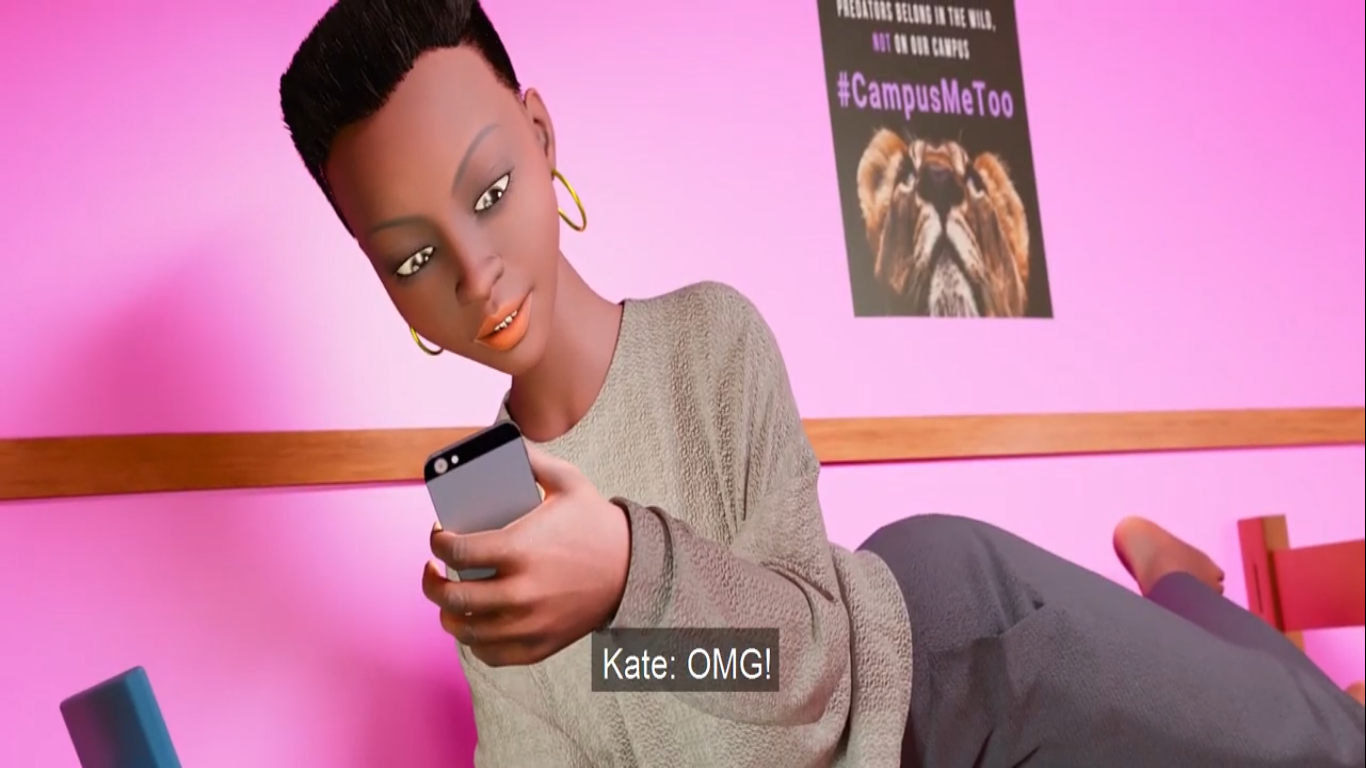
A colourful animated video fills my computer screen, palm trees waving in the wind behind the University of Today entrance gate, where a sign marked #CampusMeToo hangs in bright blue and purple. In the next shot, I see inside a lecture room. A teacher stands by the chalkboard in front of seated students. “Hey young girl, stand up!” (Imara.TV, 2019;0:11) he says to a girl sitting at the front of the classroom, “Why do you look so serious? What’s your name?” (ibid.; 0:14-0:16). The girl tells him that her name is Lindah, and he replies : “Wuuu, beautiful name for a beautiful girl!” (ibid.; 0:19-0:22) while the students in the back giggle. In the next scene, Lindah tells her friend that she’s failing her class and doesn’t understand why. Her friend tells her the reason is that she turned down a coffee date the professor invited her on. In the middle of their conversation, Lindah receives a message from him with a nude image of h im saying: “Hey beautiful”. Lindah‘s friend encourages her to report this behaviour, so she talks to the Dean of Students. He tells her that there is zero tolerance for sexual harassment in the school and tells her she can trust him while hugging her and groping her ass. She runs out crying and goes back home. Her friend tells her that they will fight this injustice and hugs Lindah while looking into the camera, saying: “Sign the petition” (ibid.).

I am sitting on my couch, in my apartment in Copenhagen, with my phone in hand while watching the video. I can see this important message from the comfort of my couch, when it was created for and about students in Kenya, which is enabled by th e Internet and the possibilities it affords. People are on their phones every day, maybe for hours, scrolling through social media where content similar to that posted by #CampusMeToo pops up in -between. Perhaps it catches your attention, something colourful, quick and exciting. You stop and read the post, and maybe, double click the image and thus give a like, or even more than that, you are approving the message. You support the statement. That is what you want to say with this ‘like’, which took you less than a second to make and voila, you have stated your stance. And you continue scrolling, and the next post that catches your attention is of a dog, with a voice- over telling you which clothing outfits he would have worn, if there hadn’t been a COVID-19 lockdown for the whole past year. “#CampusMeToo is a campaign that was created in 2019 when student union leaders from three Universities in Nairobi came to gether intending to eliminate sexual harassment towards students in higher learning institutions ” (Smaradottir, 2021;5) . The campaign was initiated by volunteers involved with Action Aid Kenya (AAK), a non -partisan, non-religious development organisation w orking in Kenya since 1972. The campaign’s activities revolve around demanding changes and making interventions for on -campus violence by involving students, staff, the institution and the national government as part of this goal (ActionAid, n.d.). Imara.TV creates the videos about GBV on behalf of AAK for #CampusMeToo, one of them described at the beginning of this introduction. “Imara.TV is a non -profit organi sation that broadcasts free videos that tackle issues such as GBV and that are often seen via smartphones, as they post their videos and other messages on their social media pages, such as Facebook, Twitter and Instagram ” (Smaradottir, 2021;5). Their work for the campaign is an excellent example of a development organi sation increasingly looking towar ds using media to achieve its goals. It will serve as a case study to look further into answering the research questions listed below.
Understanding Social Media for Development and Activism
From the 1990s, development organisations increasingly used media to promote their work (Loftsdottir, 2015), as media platforms became places where people sought knowledge and information (Berns, 2001). New media continues to play an important role in painting the image of the current world (Kapoor, 2013) . That entails posting information on social media platforms and hoping for reactions from the audience, which will then help spread the messages further through their online networks. Loftsdóttir (2015) highlights concerns regarding such a tactic, saying that when devel opment organisations look to the entertainment values of new media platforms, it can lead to development work becoming focused on popularity and thus disconnected from political discussions. On the side of individual users, due to the ubiquity of devices in people’s everyday lives, social media platforms have become a part of a routine for people. Clicking, viewing, sharing, liking, mentioning, and re -tweeting seems like a simple act that demands little or no thought process. Dennis (2019) describes ongoing criticism on the effectiveness and impact of online campaigns, which mostly centre around the notion of the individual acts - simply clicking “share” or “retweet” - can make a difference in the world. Dennis argues that an online campaign is unsuccessful if it fails to turn an online activity into offline mobilisation, which connects to missing genuine commitment. It is an excellent example of a phenomenon called slacktivism; click a button and become an activist (ibid.). This thesis, however, starts from the perspective that understands the value of social media for development organisations. It is necessary to consider a digital network perspective, which places the individual at the forefront as a meaningful actor who has agency and can influence technology usage and life decisions. Such a perspective also highlights the user’s context when participating in online discussions, forming a meaningful part of a digital network. In this way, I move away from notions of mass movements in public as the only phenomena that drive participation and success, incorporating the private everyday life of individuals and how that, in turn, has the effect of shaping offline actions. I examine how, when social movements adopt the usage of hashtags, they aim to promote a viral circulation of tweets across their Twitter network, as individuals connect when tweeting as they are enabled to find each other through the hashtags and by searching for significant tweets (Bonilla & Rosa, 2015; Sharma, 2013). Human actors, tools and t echnologies become a part of an intricate participatory social web of relations where the line separating them become hard to draw and creativity and collaborations get to thrive (Sharma, 2013). When considering development organisation’s work online, wha t is hoped for is to create awareness through the opportunities afforded by social media and gather supporters to fight in solidarity, which is a macro -vision of digital activism. What is often dismissed as slacktivism is described by Dennis (2019) as the organisational management of digital micro- activism, which provides a democratic shortcut to power sites for the general public. A mobilisation strategy is enacted by groups fighting for a common cause through personalised networks aiming for interconnected tactics blended from online to offline spaces. Dennis cites Tufekci (2014): “these symbolic, epistemic acts online – derided as “slacktivism” – may well be among the most important effects of the Internet” (p. 4). The importance is well reflected by what Bakardjieva (2012) defines as subactivism: “a kind of politics that unfolds at the level of subjective experience and is submerged in the flow of everyday life. It is constituted by small-scale, often individual, decisions and actions that have either a political or ethical frame of reference (or both) and are difficult to capture using the traditional tools with which political participation is measured. Subactivism refracts the public political arena in the private and personal world” (p. 86-7). Subactivism is also reflected in “intimate publics”, which is defined as “the effect of feeling political together”, which is something that Chen et al. (2018) argue that people may experience when rallying around a hashtag. My focus throughout the thesis will not be placed on technology but the people behind the screens: the users of devices and social media platforms. To capture a broad view of the purpose of digital activism for organisations, I incorporate Bolin’s (2007) explanation of the importance of social and institutional structures when it comes to digitisation, as it affects three areas of media consumption: production practices, distribution technologies, and audience reception (p. 237). These three pillars lay the grounding to answer the research question: How does digital activism help development organisations reach their goals (if at all)? The sub - questions revolve around answering each of the three areas . For production, I ask ; how do employees at AAK and Imara.TV and student activists that participate in #CampusMeToo view the campaign’s online presence and content creation? For distribution, how does social media help the #CampusMeToo campaign, and how do they seek to translate what’s being done online to bearing fruit offline. Finally, when it comes to the audience, in this case, it’s the student at Universities in Nairobi; what are their personal opinions on #CampusMeToo content and presence in online and offline spaces? To fu rther my stance when it comes to showing that digital activism serves as an essential component for organisations, I incorporate the view of Dennis (2019), who rejects the assumption that online engagement is easy and Sharma (2013), who explains how: “onli ne hashtags are ‘real’ as particular groupings of users connect with one another which offers a creative potential of becoming” (p. 55). The Significance of Local and Personal Activism for Development This thesis speaks to the value of online activism for development organisations. When placing #CampusMeToo online, I argue that people are provided with new spaces to feel like they are not alone, while in reality often being placed alone in front of their phones or computers. Individuals are getting the chance of grabbing tools provided by social media platforms to take ownership of their own lived experiences by using those tools to fight against GBV in their universities. I also emphasize that online spaces have been increasingly helpful for young people du ring COVID19 when most people leave campus and study from home. When returning to campus, the tools and information found online is something that the students will have for the rest of their studies while also participating in the fight. What students hav e also gained are online social networks that provide individuals with the space to feel trust, trusting that they can share their stories without being judged and gain support from it , while also contributing to the campaign. Thus, this case shows how onl ine activism can represent both a networked community and online platforms serving as a safe space for people who want to participate in the campaign and share their stories through their devices. The arguments stem from the importance of Communication for Development, which is emphasized and defined by the Rome Consensus in 2007 as: “a social process based on dialogue using a broad range of tools and methods. It is also about seeking change at different levels, including listening, building trust, sharing knowledge and skills, building policies, debating, and learning for sustained and meaningful change. It is not public relations or corporate communication” (Tacchi et al., 2009 ;582). Communication for Development is a pillar of social change as it enables dialogues and awareness of social and structural problems. In this regard, Tacchi et al. (2009) speak of the growing call for local content production promoted by new communication technologies to facilitate a diversity of voices. The focus on Imara.TV brin gs forward a local perspective of content creation, made by an organisation which works towards social change by using social media platforms to share their message and creating networks of audiences. Bringing the focus towards a local context, and the loc al appropriation of the mobile phone is emphasized by Miller & Horst (2013) who underline the importance of listening to the culture and how it has determined what that technology becomes in the local setting. The inclusion of the offline context is vital to understand online usage (ibid.) and is something that I incorporate through an ‘in situ’ approach, which explains why individuals look towards using online spaces, which refers to the offline context and is grounded in taboos and cultural customs, which will be further described when the local context is introduced. My research focus and interest were captured when seeing the short films made by Imara.TV posted on social media, as well as the pictures and texts, posted online. When digging deeper into the topic, I found out that “student activism is an international phenomenon, but there is little research on how it has played out in contemporary African societies ” (Bosch, 2017; 223). The same can be said when it comes to the effects of online campaigns a gainst GBV on the lives of university students in Nairobi. As most young people in Nairobi have smartphones and seek a bulk of information through online platforms, it seems that in today’s world, the connection between technology and people must be researched further while looking into the importance of how it is playing out in the offline world. Due to COVID19 limitations, I wasn’t able to travel, and thus my research lacks an understanding of everyday experiences that explain the why of online behaviour through a more detailed account. I encourage further research to be done in such ways and for that to be grounded in participatory development practices. The matter at hand is fundamental because feeling safe at school is essential for students to focus on their studies. It affects the continuation of studies for too many university students in Kenya, who now feel safer due to lockdown, being able to participate in teaching through online platforms from the comfort of their devices. Structure of Thesis This thesis is structured into five main chapters. The first one presents relevant literature on development organisation’s usage of media with a focus on Communication for Development (C4D) and Information and Communication Technology for Development (ICT4D). I also describe the key concepts and terms that frame an understanding of digital activism and network theories. In the second chapter, the local context is introduced, with an overview of GBV in Kenyan culture and Universities in Nairobi. I will also pre sent the increased usage of smartphones in Kenya and its effects concerning online activism. In the third chapter, the methodological approach is presented, providing an overview of the methods used for data collection. In the fourth chapter, the research findings are divided into three main themes: the collective power created through online activism; the trust formed online and the creation of social media ‘tribes’; the individuals behind the screens and how they experience being alone but together, fighting towards a common goal. Throughout the analysis, participatory digital storytelling is highlighted. It plays a vital role when enabling people to feel like their voices are being heard as the organisations are listening to them. In the final section, I summarise the findings while also reflecting on the previous discussions, future research, and broader implications regarding media and development organisations.
State of the Art The literature is extensive when it comes to both media and digital activism. Throughout the first section, I will focus on development organisation’s media usage in their work and how it’s affected by modernisation theory in development agendas, which comes clear when speaking of participatory approaches. When focusing on C4D and ICT4D, the agency is moved away from technology towards individual users. That approach also shows the importance of the local context, from which the users participate in the activism, which is extremely important to consider and moves the method further away from one -size-fits-all ideologies towards participants' agency. In section two, I will speak of digital activism, focusing on feminism, young people using online spaces to make sure their voices are heard. Ther efore, I highlight ‘hashtag feminism’, which explains how people have been brought together to a common cause through a hashtag to have their voices heard. In contrast, I speak of theories related to slacktivism but end the chapter by underlining the impor tance of online activism, focusing on effects on the offline sphere and influences on people who need support. I bring the focus towards social networking in section three, as it sums up what has been spoken about thus far and brings the discussion of indi vidual’s relations to their devices concerning bigger common goals even further by using the concept of ‘subactivism’.
Development Organisations & Media
Media criticism became a foundational tenet of feminism by the 1970s, according to Douglas (2019). She tells the story of Robin Morgan, who organized demonstrations in collaboration with other feminists against the Miss America Pageant in 1968. Douglas thanks second -wave feminists for laying the groundwork for such protests against the media. Sh e names Betty Freidan as one of the founders as she wrote The Feminine Mystique in 1963, but in her book, Freidan had suggested that the mass media promoted and bolstered sexist ideas about women. Dismissive stereotypes on screens were repeatedly misrepres enting women, but in 1970 networks had to give airtime to prominent feminists, which was extremely important as that was where Americans learned of the movement. With third -wave feminism, in the mid -late 1990s, women started to focus more on sexual harassment and violence against women (ibid.). During the U.N. Decade for Women (UNDW) in 1976-1985, the main goal was to find ways to incorporate women into development planning. There was a considerable growth of feminist organisations throughout the world, which resulted in knowledge production and conversations between women who wanted to incorporate global viewpoints into movements that worked towards gender equality (Bunch & Carillo, 1990). Bourque & Warren (1990) explain how there was a significant focus on the relationship between technological innovation and development and the effects this relationship could have on gender and women in the third world. Concurrently, technology was mainly connected to western modernisation, which was regularly transferred to the third world without further consi derations, which resulted in poor results for the country's resource distribution (ibid.). According to Loftsdóttir (2015), development organisations started increasing their media usage in the mid -1990s, which popularised development work. In addition, marketing campaigns became increasingly popular as people were encouraged to buy merchandise to become global citizens that would help solve world problems in the true spirit of neoliberalism. Berns (2001) argues that using media to gain attention is an effective strategy since people often seek understanding by viewing how societal problems are presented through media. Loftsdóttir (2015) quotes Kapoor (2013) saying that the method of using media and celebrities in today’s society is critical, as new media pl ays an increasingly significant role in constructing the current image of the world. Loftsdóttir discusses the effects of developing organisations increasingly using the entertainment value of mediums to get political messages across. Still, she considers that these methods can lead development work to become disconnected from political discussions. Mackay (2015) brings about the proximity of mediums in everyday lives and how they can affect an individual's political agency. He talks of the mediums' role in campaigns and their value and considers if technology only serves as a device used parallel to cultural and political movements or if their role is more significant. They could even bestow revolutions like feminism that they need to reach their desired go als. To show my stance on that matter and underline the importance of online activism for campaigns such as #CampusMeToo, I will introduce the concepts of C4D and ICT4D.
C4D & ICT4D
Tacchi (2012) speaks of C4D and ICT4D in how development communication the ories have evolved from modernization theory frameworks to participatory paradigms. Participation was promoted regarding evaluation in the 1960s and 1970s in opposition to mechanistic approaches (Noske-Turner, 2017 ;82). “Participation” is one of those buzz words that experienced a renaissance in the 1990s with its widespread usage in development rhetoric and was argued to signal a paradigm shift, as it reversed pre -existing power relations in development work (Chambers, 1994). While modernisation theory sees technology as a way to change a country’s socioeconomic status, the participatory paradigms bring forward ideas of communication as exchange and are “highly complementary to new digital communication environments, because it promotes horizontal and partic ipatory models of development rather than vertical, one-way, top-down or trickle-down models more suited to modernization and economic growth approaches to development” (Tacchi, 2012; 227). In that light, Tacchi (2012) brings forward how the ideas of moder nisation which are grounded in moving different societies forward on the pathway to development, where the introduction of technology is involved, can be seen as engrained in current development agendas. When technology is regarded as transformational, creating new knowledge economies and solving the development problem for their effectiveness, it is disconnected from people ’s freedoms and capabilities but coupled with information systems. The term ‘digital divide’ thus notions towards the ideas of moderniz ation, as it indicates those ‘who are part of’ and ‘those who are not part of ’ and has in many cases been replaced with ‘digital inclusion’ to describe the relationship between technology and development (ibid.). Ginsburg (2008) also critiques this govern ing metaphor concerning how modernization influences development project’s agendas in ways that marginalize groups rarely included in popular accounts on digital media. She links terms such as the ‘digital age’ and ‘digital divide’ to shaping our world views, as the charm of providing technology comes from well -intentioned concerns of inequality but is instead invoking neo-developmental language that paints the picture of less privileged cultural enclaves being “left behind” if not receiving attention from digital epicentres (Ginsburg, 2008). Cultural studies began to contest the emphasis on the power of media, arguing that the consumers of mass culture interpret the messages directed at them and transform their meanings, rather than only being passive objec ts of manipulation (Feenberg, 1999). When viewers watch television, they can impose their interpretations on shows and movies, and the same can be said about users of devices, as they can use them following their own values (Feenberg, 1999; Hermanns, 2008). A new paradigm emerged alongside the Internet, centred around the relationship between humans and machines, indicating that the personal computer replaced the agency on the individual (Feenberg, 2017). Agency is here seen from the Ahearn (2000) explanation as a person’s ability to do things, grounded from scholars around 1970, who criticized the individual’s absence in structuralist theories, saying that society structures individuals in the same way that individuals structure society as a whole (ibid.). Alongside the new paradigm, user’s agency was inspired in the technical sphere and how individuals play an active role in technological changes, which Bakardjieva & Gaden (2012) explain as the de - centralised move away from mass media towards pursuits of th e reflexive self, which means that the user becomes the manager of oneself by being reflexive towards the contradictory information thrown his way. The interactive nature of the Internet offers this kind of mediation. It allows the individual to reach hims elf, from the local setting, towards global information, opening up a new forum or space for people’s self (ibid.). When it comes to ICT4D, the participatory paradigm shifts the focus, moving the agency away from technology towards the people using it (Chambers, 1994). This shift has the effect of withholding the status of technology having the power to transform development, when more emphasis could be placed on listening to the people, which would enhance the possibility of democratic participation through new media platforms (Tacchi, 2012). To bring active listening into practice, what needs to be addressed is participation being used as a cosmetic label, making whatever organisations propose to appear as good. In reality, those projects often entail tha t local people participate in the manager’s projects when it should be “us” participating in “their” projects, where top-down becomes bottom-up (Chambers, 1994). This view is shared by Cornwall & Brock (2006), who argue that development agencies use the word to portray a picture that shows them as “guardians of rightness and champions of progress” (p. 1055). Goals become myths as people are made to listen and feel ‘rightness’ when the concepts are appropriated without swallowing them as a whole, enabling authority to those who seek it (ibid.). Language can thus smuggle in a set of assumptions that can increase ethnocentrism, as different cultural contexts are dismissed when digital technologies are taken up. When the word is used without any real meaning, pa rticipants are co -opted without any real agency as they don’t get to contribute, and locally driven identification of problems and knowledge is left out (Noske-Turner, 2017). The people-centred principles are left out, and the status quo is withheld by only using the correct name to describe a project without any action attached. Chambers (1994) sums it up nicely: “Participation as empowering process implies loss of central control and proliferation of local diversity. The powerful are threatened with loss of power” (p. 4). As Horst (2012) argues, when looking towards the usage of new media technologies is bringing the focus back on the domestic space as cultural life is enacted through various screens situated in the home. Thus, even though meanings are being made in networked communities, it is vital to incorporate the location and context of these activities. The domestication of technological objects is reflected by Tacchi (2012), who underlines how preferences towards “seeing ‘one knowledge system’ fails to appreciate the political nature of knowledge and the importance of multiple knowledges” (p. 228). Local knowledge gives value to the participatory approach as it gives insight into how the implementation of development interventions or changes in local knowledge should be carried out (ibid.). Incorporating local knowledge can be done through an ‘in situ’ approach, where the understanding of new media among the people within their context is embodied. The approach allows for a focus on how engaging with media can be seen as a part of a larger mosaic of collective identity work (Gray, 2009), which I will incorporate and introduce further in the methodological section. Adopting an ‘in situ’ approach does not incline the denial of digital technology’s global reach and aspirations of transnational networks but allows for a consideration of how media has become central to modes of being in the world and displays how, where and why digital media culturally matters and thus going against the universality of digit al experience (Coleman, 2010). To move away from universality, I focused on locality through this chapter by introducing C4D and ICT4D, which incorporates horizontal communications and user’s agency. Feenberg (2017) sees this as laying the ground for evoki ng participant interests, enrolling individuals in networks as users, and forming micro-political activism, thus paving the way for a discussion on digital activism.
Digital Activism
By 2004 a popular hype about digital technologies resurfaced following Web 2.0 technologies. Social media seemed to allow for more communicative interactivity, social connectivity, flexibility, more democratic participation, creativity and user -generated content (Coleman, 2010;489). “Social media is a group of Internet based applications that build on the ideological and technological foundations of Web 2.0, and that allow the creation and exchange of user generated content” (Kaplan and Haenlein, 2010 ;162). Kaplan and Haenlein (2010) provide a classification of social media and call the relationships that link people together via social media Social Web. These new communication environments made up of digital technologies provide and maintain safe spaces and platforms that cannot be found in traditional media. Tacchi (2012) prov ides a comparison, where the opportunities provided by new and social media are grounded in horizontal patterns of communication (from people to people), communication networks, many information sources, difficult to control (increased voice and trust), an d where people can ask questions. On the other hand, traditional media provide unipolar communication systems that stem from vertical patterns (from the government to people), few information sources and easy to control when generating accurate information (p. 235). According to Juris (2005), these horizontal networking patterns create alternative forms of social, political and economic organisation, changing their organisational logics to decentralized, flexible local/global networks, making them adaptive to the activists involved through transnational coordination and communication. Cell phones have become multimodal tools for extending sociality and reinforcing friendships while transforming social coordination and kin networks patterns when transmitting voice, sending texts, and taking photos. By doing so, cell phones can assume symbolic power, mainly when used during street protests (Coleman, 2010) but as Hermanns (2008) argues, the phone has become a tool for political activity and mobilisations and thu s evolved from simply being a chatting device. The impact of the telephone, in particular, can be explored through the building of networks and online public spheres, which will be brought to focus later on. For now, I will move the lens towards how devices and social media can be used to mobilise activists, focusing on the usage of the hashtag for feminism.
Hashtag Feminism
The hashtag was developed on Twitter in 2007 to help sort information but grew into enabling people to provide context, meaning and emotion in their tweets, making it easier for people to highlight what they think is news, draw attention to issues and find others that share their viewpoints. Through time, they have grown through the idea that people tend to imagine that they have an audience on social media and hashtags are used to form a movement and fight for social change (Chen et al., 2018). Douglas (2019) describes the new generation of scholars and their focus on possibilities for women regarding the Internet and social media. Throu gh the digital environment, feminists are gaining a unique platform where media texts are consumed with new challenges and opportunities. “Hashtag feminism is one of the most popular forms of feminist activism and involves using hashtags (the # symbol foll owed by a thematic word of the phrase) to produce communities of conversation among disparate Twitter users” (Mendes et al., 2018 ;2). Hashtag feminists use Twitter to create discussions around women’s experiences and patriarchy, which then get more significant by using subtweets, blogs and Facebook (Dixon, 2014). According to Feenberg (2009), Facebook, Twitter, and Instagram can be counted as a digital public sphere. People are brought together and can have their voices heard as a part of transnational political participation. But during the early days of the Internet, a culture of fantasy through virtual environments emerged among so me scholars. They imagined that people would go online to escape their embodied racial and gender identities built on the 1990s telecom commercial renderings (Daniels, 2016). Daniels (2016) speaks of Martin and Valenti (2013) , who provide an historical acc ount of online feminism, describing the emergence of feminism using the Internet to share stories as largely accidental , as w omen had created a feminist movement online without realising they were building the next frontier of the campaign. Daniels uses Arreola’s (2013) arguments to answer this, referring to the extensive feminist online organising from the mid-1990s to the present, which she describes as being far from accidental. The era of digital activism is presenting new opportunities for feminism, es pecially Twitter and the proliferation of hashtags, as people are forced to hear everyone out. Women of colour no longer need the platform of white feminism since social media is providing them with their own microphone, as all women can share their experi ences and learn about each other's realities (Daniels, 2016; Fotopoulou, 2016; Baer, 2016). Onyejekwe (2011) connects these new media opportunities to organisations, as they can use the Internet to open up for conversations regarding political issues, such as gendered spaces and silenced voices. Mendes et al. (2018) show , through interlocutor’s answers who explain how historically, women have had very few spaces to meet up and discuss ideas . That is now provided by social media, where feminism is developed by providing knowledge and opportunities for learning and dialogues. Mendes et al. (ibid.) found that participants understood the digital sphere as a relatively safer and easier space to engage in feminist discussions when compared to offline spaces. They also found that when people were involved with feminism online, they were often met with clashes in their offline everyday lives, as they experienced being able to share their opinions and receive support online while feeling dismissed by their significant others offline. According to Chen et al. (2018), social media thus enables the gathering of women in hashtag feminism, which is conceptualized by Dixon (2014) as a “ virtual space where victims of inequality can coexist together in a space that acknowledges their pain, narrative and isolation” (p. 34-40). Mendes et al. (2018) speak of the #MeToo movement. They show how digital feminist activism brings about the public’s willingness to engage with both resistance and challenges to sexism and other forms of o ppression through digital communication. By using digital platforms to do so, the public is fighting back to power relations connected to patriarchy and what is bound to happen is opposition. Activism online, especially digital feminism, is often met with fury and backlash, but, the intense Internet-based backlash movements are precisely what Washko (2014) suggests as a measurement for the movement’s success. These components can serve as a validation of the existence and the extent of the original movement itself.
Slacktivism
Bosch (2017) underlines that social media has provided increased opportunities for engagement in collective action and protest participation. She also brings forward the importance of caution against cyber-utopianism, “that the Internet can help to democratise authoritarian regimes and that it is responsible for political and social change, as in the case of the Arab Spring” (p. 224). Many online campaigns set a goal of as many people as possible share a hashtag or sign a petition which is some times referred to as s lacktivism. Vink (2018) uses a definition from Knibbs (2013): “any time you endorse a cause on social media or sign an online petition without taking any corollary action outside the digital world” ( p. 67). The trap that is easy to fall into is that the information flow makes it too easy for people to dig deeper into the issue. According to Vink (2018), two opposite sides have emerged concerning slacktivism; one stating that the actions made online have value and make a difference while the other believes that people are falsely convinced of having done something for the broader world, while in reality, they are not supporting the cause or might even be hurting it. “In this worldview, a click is just a click, and a post is just a post” (Vink, 2018;68). The proponents of slacktivism argue that when individuals engage in digital activism, like sharing a hashtag, that can make them less likely to engage in a more active form of activism, because sharing is enacted to liberate the ir consciousness and give them peace of mind when looking for moral balance. What is argued is that social media provides a sense of imagined intimacy which heightens the participants' emotions to feel like they sense solidarity (Chen et al., 2018). Vink ( 2018) gives the example of a study published in the Journal of Sociological Science about the Save Darfur page, one of the most significant causes of Facebook. The study's authors concluded that the page gives an ‘illusion of activism’ based on the data showing that of the more than 1 million people signed up for the page, less than 3.000 donated money to the cause. Another example given is when people change their Facebook profile pictures to show a flag of a nation that has been under terrorist attack, wh ich does not create any change. Still, the people nevertheless feel like they are doing something. Critics say that this action can be explained as being self -congratulatory, as individuals might want to portray a picture of themselves as activists or politically aware (ibid.). The stance of slacktivism is vital to consider but to underline my perspective on the matter; I refer to Chen et al. (2018). They explain that the argument of slacktivism would make sense if hashtag feminism wouldn’t foment significant change and lead to actions. To dig deeper into the importance of online activism, I will speak further on that standpoint which can be seen as beginning at the individual level, as online experiences can indeed have real effects on people’s everyday liv es. The lead to actions is thus not something
“Is it possible that, for the rural youth who stay put, new media serve not primarily as “opportunities for the formation of new communities… spanning vast distances” but as opportunities to create and consolidate networks much closer to home that are otherwise absent from mass media representation?” (Gray (2009;1166) citing Gross, 2007; xi). “With the development of the World Wide Web in the 1990s, early services based on the social networking paradigm were developed in the form of generalised online communities [...]” (Carminati et al., 2014 ;7). Carminati et al. (ibid.) explain the further development in the late 1990s, where social networking sites allowed people to find friends and search for others with similar interests.

Wasserman and Faust (1994) bring forward a definition of a social network; “a social structure made up of a set of social actors (such as individuals or organisations) and a complex set of the dyadic ties between these actors (such as relationships, connections, or interactions).” (p. 275). Carminati et al. (201 4) discuss the meaning of community and how the definition has developed over the years. They bring forward Durkheim’s (1951[1897]) description as a private and intimate place that stands for the basic needs of individuals. From more recent literature, they bring up Turner’s definition, which sees community with liminality. “Liminal moments refer to life events not subjected to instrumental rationality which create a powerful bonding between members of society. In his vision, one obtains a feeling of belong ing and relating to others when not being subjected to rules, laws, norms, etc” (ibid.; 4). By focusing on social networks and community, I hope to show how the two have increasingly entangled, creating a new space online. That space is what Boyd (2010) ca lls ‘networked publics’, which she describes as collectives that emerge and allow people to gather and connect beyond their close family and friends, with new possibilities for interaction. Before examining and analysing what those spaces offer online acti vism and the people involved, I want to introduce the hashtag’s vital role in its creation and underline its effects on people’s everyday lives in the offline world. According to Vink (2018), online activism has beginnings in grassroots organisations, as it often consists of ordinary people who have come together to fight for a particular cause. “In grassroots movements, social networking is a tool that connects the thoughts and opinions of many individuals. One of the more important parts of social campaig ns is creating a sense of solidarity in communities. Solidarity is the endgame for many social activism movements because some problems in society are either not well -known or too big to solve all at once” (Vink, 2018;45). Boyd (2014) argues that even the simple act of hanging out online, sharing one’s thoughts and listening to other opinions has excellent potential for creating networks that support ‘real’ -world political engagement. What Boyd (2010) raises as shaping networked publics and solidarity are the connections and networks that link people together in new ways— in online activism, made available by hashtags, making it easy for people to search for particular tweets and discussions. “A key characteristic of hashtags is that they operate as replicators, spreading via repetition. Hashtags make available the re -tweeting of the whole message they embody or tweeting a new message via the existing hashtag. Either way, to (re - )tweet a hashtag continues its propagation through the Twitter network and increas es the potential for contagious effects to take hold” (Sharma, 2013 ;62). Hashtags set the stage for what Boyd (2010) explains as making public networks available, connecting people and space provided for the flow of information and interactions (p. 6). Boyd (2014) aims to bring forward the vision of teenagers creating their publics through cyberspace rather than fighting for places already occupied in the offline world. She argues that the Internet appeals to young people as it provides them with space w here they can be a part of “a broader public world while still situated physically in their bedrooms” (p. 201). Horst (2012) explains how computers and other objects become extensions of the self or the imagined possible self through material projections. Thus, new media technologies and the networked media manage to “extend and challenge earlier conceptions of technology appropriation ” (Horst, 2012;63).
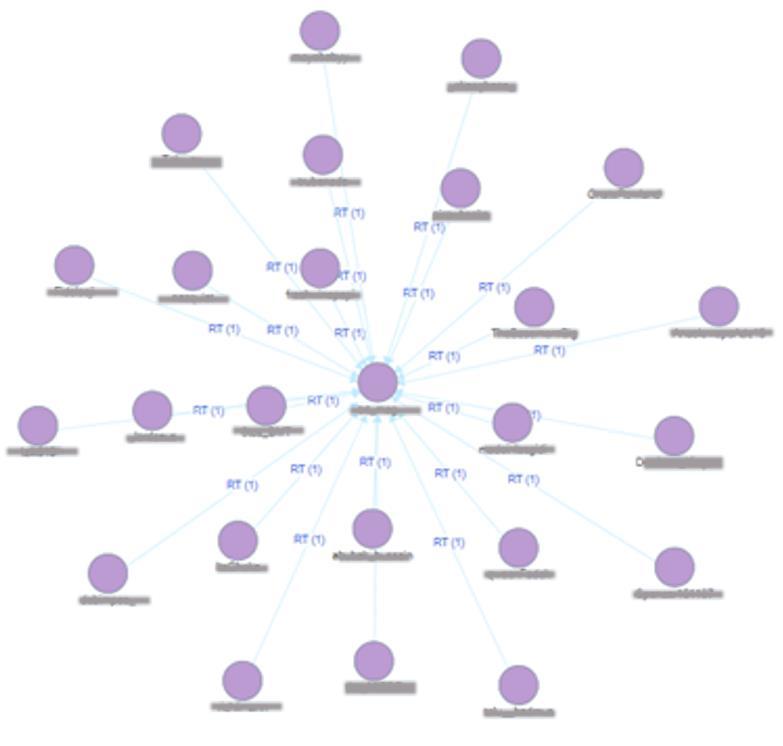
Giddens (1990) was the first author to introduce the concept of a virtual community, which he describes as being rooted in cyberspace and forming an alternative reality with capacities to transform society. Castells (1996) incorporates virtuality as a part of the real world and argues that social relations are modelled by the individualism inherent in society and have not changed due to the global network society itself. He goes on by saying that localities become disembodied from their cultural meaning and integrated into functional networks, “inducing a space of flows that substitutes for the space of plac es” (p. 82). The individual becomes the centre within personalised networks created through individuals participating in cyberspace. The importance of these networks in the context of activism can be found in Hermanns (2008) explanations, who explains that recipients of messages tend to put more trust into received information from a personal message or a known source from their network, making them likelier to listen and follow a piece of advice, such as showing up for demonstrations (p. 77). The Internet has its norms which are based on interweaving online and offline worlds. Past worries often consisted of telephone relationships impacting ‘real’ ones and even replacing them, while ‘real’ relationships are framed as opposite to virtual connections. What i s missed is the complex reality of relationships online actually being ‘real’ (Miller and Slater, 2002). Horst (2012) uses the concept of double articulation to describe how technical devices are objects and link the private sphere with the public when facilitating the negotiation of meaning through their usage. Things go through social reproduction within the household and gain importance by defining a semantic universe concerning what is offered in the public world (ibid.). Miller & Slater (2002) provide evidence suggesting that online and offline worlds saturate each other in complex ways. People use the Internet to realise concepts of identity and pursue new modes of sociality. “With respect to the family the Internet is used largely to roll back changes that were dissolving some family relations. It is used to bring people back to what they think of as ‘proper’ family life” (p. 207). Chats and online communications can develop new kinds of social contact, which Miller & Slater suggest has to be assessed to normative ideas of a ‘real’ relationship. Waltorp (2020) follows the same approach in her research, as she doesn’t see online spaces as being parallel worlds for her interlocutors, but, as an integral part of the worlds they live in, as it plays a significant role in their everyday lives online and offline. Thus, the digital world is shown as being very real for the people being studied, not as something unreal compared to their face-to-face interactions. Juris (2005) adds to this approach that rather than seeing the Internet as replacing face -to-face interaction, it has complemented and facilitated them by building relationships throughout online spaces, independent of physical settings. A personal reality can be created and experienced as real through i ntimate levels of connection and communication, even though it isn’t happening through face -to-face communications. Tacchi (2002) explains this creation as building the desired society, which is different from real-life interactions in some way but is never theless a part of ‘real’ sociality. “The relationships established between self and others are significant, and complementary, in a larger scheme of sociality, and they are present within real lives, not merely imagined” (p. 255). She explains that even though some of the relationships that the interlocutor she speaks to experience may exist in part in their imagination, they directly impact them as persons (ibid.). Gray (2009) stresses this view when researching online communities, saying that critical cyberculture scholars call for further examination of how online contexts both influence online situations and offline experiences, as the Internet should be recognized as intertwined with the fabric of the rest of life. Mendes et al. (2018) manage through their research to show how girl’s and women’s involvement in hashtag activism is genuine, which is evident in how their interlocutors describe the carefully produced testimonials that they shared through their Twitter accounts. One of their participants explained the emotions that follow when being a part of a hashtag, which were described as upsetting, challenging, and demanding, even though it was considered positive to share and read other women’s experiences. They also expressed how much support in the form of ‘favourites’, ‘retweets’ or ‘DMs’ (direct messages) from strangers through online platforms meant to them and that it evoked a feeling of solidarity and support through being heard. Mendes et al. (ibid.) explain that organisations are doing meaningful work and building networks of solidarity when survivors feel like they are being listened to. Online activism essentially helps survivors understand that sexual violence is a structural problem, not a personal or individual experience. The consequences are shown in the example of a girl assaulted on a university campus who shared her story with a hashtag movement. Sharing her story helped her gain strength, which she found through solidarity, to go to campus security and report her case (ibid. ; 5). Miller & Horst (2013) underline this thought by adding that by simply using the world ‘real’ analytically, we undermine the field of digital anthropology by privileging the online world over the offline one, making the pre -digital world seem more authentic. Separating my findings into ‘real’ and ‘virtual’ would not serve as a stable ground for my research, seeing that online communities create a new version of solidarity and trust that affect people’s lives in their offline spaces. Networked publics establishes the individual’s feeling of being supported. It relates to the encouragement of an individual’s participation in a movement, which is further described by subactivism and can be connected to a person being placed online behind a screen while taking part in macro-political discussions happening on the screen.
Subactivism
Washko (2014) provides a valuable framework when defining social movements, which she bases on definitions from Alberto Melucci (1996): “We know that contemporary ‘movements’ increasingly address cultural issues and tend to differentiate themselves from the mode l of political action” (p. 78). Washko brings forward Melucci’s term ‘Cognitive liberation’, which he uses to describe an individual’s realisation of issues surrounding a movement and that the individual is indeed not alone, as the hope for action and change is encouraged by a collective (ibid.; 2) . Bosch (2017) identifies similar tendencies when young people increase their networking sites for activism. She argues that youth are developing a new biography of citizenship symbolised as an individualised form of activism while also being a part of its more extensive socio-political discussions. Bosch (2017) explains how social networking sites have promoted participation in protest behaviour among young people. By providing access to many contacts and serving as information hubs, social media sites inspire interests while also creating a shared group identity. With social media starting to play such a central role in political activism, Bosch describes how the connection is made between “the private sphere of autonomous political identity to a multitude of political spaces” (p. 224). Subactivism reflects this, as people may feel a sense of personal empowerment when turning to this new form of political participation, which is reflected in self-actualisation leading to young people fighting towards specific issues. Bakardjieva (2012) provides a perspective on the Internet as growing the visibility of “counter publics”, which are groups that share an interest in something that is not represented in mainstream publi c discourses. Through the online space, the enrichment of everyday practices of citizenship on the level of individual agency happens, creating a “cultural turn” when it comes to democracy and political communication, as it is involved in collective identities often in an imagined form. Bakardjieva (ibid.) argues that subactivism is rooted in micro and macro conversations. We see the person who participates in morals that they want to follow through an ongoing dialogue with large-scale political confrontations. What the individual might essentially be looking for when both reading other’s stories and sharing their own experiences is a feeling of solidarity and familiarity. As this is something provided online by networked publics and hashtag activism, I now move the lens more towards these online spaces and dig deeper into why they have become a place of trust in Kenya.
Background
Gray (2009) addresses the need for more relational methods when studying and understanding media and suggest using the term ‘in situ’, which means ‘in place’. It incorporates more than a description of a location. It goes beyond the moment of the audience’s receptions and reactions to online content, as it takes the process and understandings of new media among young people within their context into account. “A media in situ approach focuses on how media engagements fit into a larger mosaic of collective identity work. This approach does not assume a special message or effect is (or can be) conveyed or transmitted” (Gray, 2009 ;1168). Thus, media engagement needs to be looked at beyond the reception of media content and calls for a greater understanding of re asons for engagement. Gray (2009) finds that young people go online searching for reflections of realness, as it brings people online visibility through narratives that offer comfort and familiarity.The reason why I argue that #CampusMeToo is a valuable form of online activism relates to cultural taboos and students continuing to feel like they are not being heard, as they may feel like nobody is there to listen. An ‘in situ’ approach that I incorporate in the thesis brings a deeper understanding of why students seek further media engagement when it comes to GBV, which can be explained by the socio -cultural context of conversations seen as taboo subjects in Kenya. Thus, sensitive conversations are often had through online platforms, which became my study ‘area’, made possible thanks to my devices; a computer and a smartphone. GBV in Kenya Reeves & Baden (2000) define gender-based violence as any threat or terror made by men or masculine organisations that cause physical, sexual or psychological harm to women or girls based on their gender. Omale (2000) speaks of the discrimination that women face during higher education in Kenya due to the social and economic environment, which is male dominated, that colours the student’s lives. A lecturer at Kenyatta University explains how this behaviour has become a daily habit in classrooms and cafeterias. Her explanations are described as “unwelcome sexual behaviour - insults, remarks and jokes, unwanted physical contact, requests and even threats - create a daily diet o f discrimination against women students” (p. 21). Omale (ibid.) explains that young women only represent 30% of the student body, which can be presented by drop-out throughout primary and secondary years. In a report made by UNICEF (2021), that works closely with the Government in Kenya, it’s reported that before the COVID-19 pandemic, primary education stood at 93% nationwide, while secondary level, which is for children from the age of 14 -17 years old, was only 53%. The explanations given for the high dropout rates are lack of schooling value, long-distance to schools and high rates of child marriage. Particularly girls in marginalized areas continue to face disadvantage by being excluded from participating in mainstream education and programmes intended f or the youth (Abuya et al., 2016). Four hundred sixty-five people attended an online meeting held by UN Women and the Embassy of Finland in Kenya, called “Harnessing technology/innovation and youth activism to effectively respond and prevent violence against women and girls in Kenya” in March 2021. The effects of COVID -19 were discussed throughout the meeting, and staggering results showed that between March and December 2020, the national GBV hotline in Kenya reported 6297 cases, which is a 446% increase from 2019 when 1100 cases were recorded (UN Women Africa, 2021; 29:22). These numbers show that the problem of GBV is not only to be found within higher learning institutions but also inside homes. One of the indicators for such high cases is the gendered spaces found in the society, as women tend to be excluded from positions deemed necessary in the culture, such as specific departments at universities and, e.g. tech jobs (ibid.). According to Mbarika et al. (2006), traditional bottlenecks have hindered women in Sub-Saharan Africa from participating in formal technology labour, resulting from women being employed in the “informal sector”, which applies to micro -businesses that stem from individual or family employment (p. 6). Women thus experience discrimination because of a gender gap found in both economic and social contexts and tend to face various constraints when trying to access “formal” employment and studies (ibid.). In Kenya, female students are underrepresented in technology and science and well-paid professional positions, which can be explained by them having more responsibilities inside the homes and assumptions that they want to get married early on (ibid.). Omale (2000) argues that if the environment doesn’t promote gender equality, abuse against women continues to th rive, which is also stressed by Austrian et al. (2017), who explain that when girls are denied access to social networks and economic opportunities, they become vulnerable to multiple types of violence throughout their whole lifespan (p. 93). “GBV is deeply ingrained in higher learning institutions in Kenya. In a study that was made by AAK in 2019 among 1,015 students enrolled in Kenyan universities, the results showed that one in two female students and one in four male students have been sexually harassed by a staff member. The study further illustrated that 66% of the student survivors were sexually harassed by a professor or a lecturer. What also became clear through the study was that the students that are mostly targeted are the ones in vulnerable positions economically and socially, as professors use their situation to demand sex for grades. The study also revealed that it’s common for students to keep silent after experiencing harassment, and this can be linked to social stigma regarding GBV. It is stated that most students don't report violent experiences due to fear of exposure or negative social consequences, both from peers and university authorities. Another factor that causes survivors to keep silent can be connected to the fact the students did not know where to report the cases or who to tell. In the research, it was found that 33% of male students and 38% of female students thought that it was unlikely that the university would take the report seriously and that they would receive protection an d support throughout the process” (ActionAid, n.d.; Smaradottir, 2021;6). Ahmed (2019) speaks of complaints on sexual harassment at universities. As she learned, it is complicated to make a complaint regarding GBV, as it is not completed by one action alone. “Students are often warned about making complaints; they are told that making a complaint would damage their reputations, relationships, career prospects, lives. If a complaint is made, it tends to be treated as potential damage, as it could damage the reputation of an individual or an organisation. There is often a concerted effort to stop a complaint from going through the system or to stop a complaint from getting out” (Ahmed, 2019;515). Her research was done in the UK but matched what I ca me across when speaking to interlocutors and my work with AAK. As presented at the beginning of the thesis, the video explains the deeply ingrained issue in higher learning institutions. Not only do the professors harass their students, but when hoping for trust from the Dean of students, the same story repeated itself. GBV in Universities has been engrained for such a long time. It has become seen as an acceptable behaviour amongst the staff at universities today, as nobody is held accountable for their actions. #CampusMeToo & Imara.TV As discussed above, #CampusMeToo is a campaign that began in 2019, when student union leaders from three Universities in Nairobi decided to bring their forces together and fight against sexual harassment towards students by s taff members in higher learning institutions (ActionAid, n.d.). The campaign is one of the projects that fall under the organisation ActionAid Kenya (AAK), an NGO working in 14 counties in Kenya since 1972. Their work focuses on women’s rights which is don e mainly through campaign work where youth play a vital role, as an underlying goal is also to empower them. The student activists are the main drivers of change for the campaign, and AAK’s position is to support and ensure the student’s safety (ActionAid, n.d.).

“Imara.TV is a non-profit organisation that broadcasts free entertainment videos that are aimed to educate youth about sexual reproductive health. The videos tackle issues such as HIV and other STDs, Gender -based violence, female genital mutilation and forced early marriages, sexual identity and rights, early unwanted pregnancies, abortion, and other issues. The content is mostly distributed through smartphones, as the videos and other important messages are posted to their social media, Facebook, Twitter and Instagram. Imara.tv works mostly with young people, as videos are produced by small groups of talented youth from Kenya. With this being said, what Imara.TV is also aiming at is providing employment for young people, but they make up the biggest percentage of unemployment in Kenya. Imara.TV’s model thus combines entertainment, education, capacity building and innovative approach to youth employment” (Smaradottir, 2021;5). When speaking to one of the managers, he tells me that as an African start-up, they are financially disadvantaged, with little exposure to interested investors, both from Africa and other parts of the world. In that context, he speaks of the difficulty of scaling up the company, which can also be related to him not even being able to run the company full time, as he has to have another job to sustain his family. The work behind online campaigns, which consists of maintaining the public’s interests, tends to be ignored and is described by Mendes et al. (2018) as hidden labour, which is often done concerning digital labour. Th e reason for that is spoken by Boyd (2010) as the attention economy, as attention has become a commodity with the emergence of new media, w hich both producers and consumers are embedded in through networked publics and tends to be dismissed. The only thing that the audience sees on their screens is the hashtags being created, while perhaps thinking the only thing needed after that is for other people to take over (Mendes et al., 2018). The work is often unpaid and the people behind the work often invest their time because of passion for the subject, but what needs to be further investigated is how to maintain sustainability of online campaigns in an environment where financial compensation is difficult to receive (ibid.).


“A collaboration was made between AAK and Imara.TV when the latter got involved with #CampusMeToo by developing content focused on sexual harassment at universities and colleges. The result was a video series of short videos called “ The Diary of a College Girl ”, showing how professors and lecturers pressure students to exchange grades for sexual favours. The aim of the collaboration was that the campaign’s main messages would be expanded in reach and hopefully prompt discussions among students and the universit y community”(Smaradottir, 2021;5). Study ‘area’ & Smartphones Throughout the research, I speak of usage of digital devices concerning the individuals who use them in their everyday lives. I focus mainly on the smartphone, as it is more accessible than a computer while also being the favoured communication device. Hermanns (2008) explains that mobile phones are cheaper than computers and easier to master. In addition, the lack of infrastructure to support fixed telephone lines in many parts of sub-Saharan Africa make mobile phones a “crucial mode of communication and welfare enhancement” (James and Versteeg 2007;117). By 2017, there were 30.8 million Internet subscribers in Kenya and “what is clear is that most Kenyans access the Internet through their mobile phones. Kenya had one of the highest mobile phone penetration rates in the developing world at a staggering 88% in 2017” (Nyabola, 2018, p. 36). Nyabola (2018) further explains that population dynamics point to most of the users being teenagers, as in 2017, 43% of Kenyans were below the age of 15 and about 60% below 30. Through phones, people access most of the applicat ions that I refer to: Facebook, Instagram, Twitter, and WhatsApp. These online platforms all serve as a place for conversations, sharing thoughts or pictures that both show the user’s livelihood and make available a space to share personal opinions and eng age in public discussions. “According to Bloggers Association of Kenya (BAKE), an estimated 12 million Kenyans are using WhatsApp, 7.1 million on Facebook, 4 million on Instagram and another 1 million on Twitter” (Nyabola, 2018, p. 36). When looking furthe r into users, most Kenyans online are located in Nairobi, with Mombasa as a distant second. These users will probably never consume traditional media in the same way as older generations do, which will undeniably have important implications in the future (Nyabola, 2018). Smartphones are vital when it comes to communications and accessing general information. That can range from being invited to a social gathering to learn what has happened on the other side of the world. “Smartphones became widespread following the Apple iPhone release in 2007, and most smartphones produced from 2012 onward enable wireless access to high-speed mobile broadband, fibre optic cables running under water and across landscapes. A smartphone is a mobile phone, or ce llular telephone, with a mobile operating system (IOS or android) combining a computer operating system with the features of a mobile phone: calling and text messaging, calendar, media player, video games, GPS navigation, and the like. It can access the Internet and can run (third -party) software components called applications (apps)” (Waltorp, 2020;37). „Mobile phones have developed a particular relationship with people, their bodies, and their lives. Mobile phones have become a personal, even intimate technology (Goggin & Clark, 2009;587). When comparing the phone to other equipment, it allows for the individual to form new relationships, connections, cultural expressions through camera-phone generated content, means of sharing, and receive message s courtesy of telecommunications networks (ibid.). Social media, often accessed via smartphones, has begun to play a central role in political activism in the Global South, providing opportunities for a networked citizen - centred perspective, which connects the private sphere of autonomous political identity to many political spaces (Bosch, 2017;224). In a recent landmark study made by UCL (Miller et al., 2021), involving 11 researchers working in 10 field sites conducting approximately 16 months of ethnography, what was found is that users of smartphones have become humans snails that carry their homes in their own pockets (ibid., p. 219). Throughout every field site, people tend to feel the same way about their devices as they do about their own homes, and it has thus become a place where we live. The researchers call apps such as WhatsApp the “heart of the smartphone” as it represents the most important thing that the smartphone does for them, forming connections between new people and even strengthening and recreating them with loved ones located far away (ibid., p. 181). Smartphones are becoming a basic necessity and challenge the household regarding the amount of time spent in them. The flip side is the “death of proximity” when it comes to face- to-face interactions, as we are learning to live with perhaps feeling alone while being physically together, as many people turn to disappear into their devices at any given moment (ibid.). While Miller et al. (2021) speak of the smartphone as one of the barriers when it comes to face-to-face proximity, as people might feel like they are alone while being in a crowd as everyone around them might be „at home“, meaning indulged in what is happening on their screens. When I imagine this scenario around a dinner tab le, where a family is eating dinner together after being apart for the whole day, one has to wonder why this tends to happen in so many households. The content on the screen indeed is captivating and exciting. Still, when it comes to essential matters such as GBV, if young people don’t feel like they can speak on the issue at the dinner table, they might find the refuge that they need through their screens, from their online networks that might understand them. “Technology is impacting normative ideas about the relationship between generations – allowing young people especially to speak out of turn, find and amplify each other. And in public spheres that still routinely silence the voices of women, digital spaces are possible for women to scream into the voi d (Nyabola, 2018, p. xviii)”. These are the words of Nyabola, who discusses how young Africans have embraced technology and digital platforms to speak up to power in their societies. She goes on further by explaining how new identities and ideas of the sel f-develop online in resistance to what went on before, by also keeping in mind that “what is being developed online is a real reflection of the state of affairs offline” (ibid., p. xviii). Throughout the interviews conducted for the research, it became clear that young people in Nairobi generally do not feel comfortable speaking of matters regarding GBV with their parents. Several interlocutors repeated that GBV is considered taboo in Kenya and can have unimaginable consequences that stem from cultural and societal norms. In many contexts, what is also considered problematic are young people’s increased usage of devices, which is thought of as having a bad influence on their livelihoods. Boyd (2014) explains how easy it may seem to focus on what is new and disruptive, such as the Internet and social media, rather than examining broad systematic changes that need to happen in society. Boyd quotes Vint Cerf: “The Internet is a reflection of our society and that mirror is going to be reflecting what we see. If we do not like what we see in that mirror the problem is not to fix the mirror, we have to fix society” (p. 212).
Methodology
“Ah, look, here is one more chicken coming!” I’m talking to Mia through Zoom, as she gives me a virtual tour around her beautiful garden in Nairobi while holding a chicken in her hand. When she tells me about the warm sun that hits her head when she walks home from her internship in the afternoons, I can hear the rest of the chickens’ cluck in the back. During the first wave of the COVID19 pandemic, in March 2020, I had my mind set on travelling to Nairobi in the coming fall to do an internship whilst collecting data. As expected, my travels fell through, but I decided to collect data in Nairobi from Copenhagen with the help of the Internet. As I began conducting individual interviews with people located in Nairobi, which were all accomplished through Zoom (a cloud -based video conferencing tool that allows for virtual m eetings or one -on-one conversations), we usually had switched our cameras on to do HD video chatting. The feature allowed me to see into the homes of so many interlocutors while meeting their family as they walked me around on their screens. Previous research has left many unanswered questions, and the data that I collected can still be considered insufficient to bring about fulfilling answers. But, to paint a coherent picture grounded in my data, clear patterns started to emerge that represen t what I’ve seen and heard faithfully. Haraway (1988) speaks of “our” problem is to represent historical contingency for knowledge claims while recognising our influences and representing accounts of a “real” world. “All these pictures of the world should not be allegories of infinite mobility and interchangeability but of elaborate specificity and difference and the loving care people might take to learn how to see faithfully from another‘s point of view, even when the other is our own machine“ (p. 583). What Haraway suggests is an approach which is not a version of “realism”, as it has not provided engagement with the world’s active agency, which is subjected to changes and follows no guarantees (ibid.). The research process's evolution happened through an iterativ e-inductive approach, which allows the researcher to go back and forth between theory and analysis, data, and interpretation (O’Reilly, 2012; 29). The study and interpretations were made in a way that O’Reilly speaks of as a voyage of discovery, as it happened through an ongoing writing process while processing the data. As the data collection took place away from the site being researched, it became challenging to set the beginning and end date of the fieldwork, which can be related to creating boundaries b etween my personal life and data gathering happening on the same computer screen. I gathered most of the data in the planned period of August 2020 – February 2021. Some of the social media analysis continued until April 2021, with further discoveries and programme constraints. To see a coherent, broad view of the problem statement, I set out using creative methods of gathering data through the Internet. I started by collecting secondary data in relevant academic articles and documents from both AAK and Imara.TV that I was granted access to. I define this information as secondary, based on their usage throughout the research, but they serve as a grounding in background information when it comes to Imara.TV, AAK and GBV in universities in Nairobi. For primary data collection, I chose methodologies to understand the value of locating campaigns in online spaces. The methods were qualitative and mainly based on open-ended interviews. Accessing the ‘Field’ I was lucky having to get to know my topic of choice through an internship with AAK. My position granted me access to valuable sites that I could collect data from, such as WhatsApp groups with volunteers of #CampusMeToo. When I was doing the internship, I also participated in a 15 ECTS course called Data Collection, which allowed me to collect data in the same period. What has opened up the field for me the most are two employees I worked closely with at AAK in Nairobi. They helped me to both find interlocutors and to get in touch with them. As I was in regular con tact with them through WhatsApp, they kindly directed me the right way, as they know the local setting and which information could be essential for my research by sending my vital tips. Both the manager of AAK and Imara.TV opened up the field for me by granting me access to documents and answering my multiple questions and thoughts via email. Our communication affected the research significantly and pushed me to look beyond my research questions and see the amount of work done by AAK and Imara.TV, both onlin e and offline.
Social Media
To weave in online experiences, I collected data on both Imara.TV and AAK’s social media accounts. Through the usage of N Vivo, the numbers of likes, shares and comments were gathered along with the numbers of re -tweets shared concerning popular hashtags connected to the campaign. To look beyond the numbers when it comes to engagement with the online content, the feedback given by users through comments on Facebook and Instagram posts provided a good ground to get a sense of peopl e’s opinions regarding the content posted. Alongside gathering their feedbacks, their location in the world also served as an essential matter to realise the campaign’s reach and popularity. While I made vital discoveries throughout gathering data, in hind sight, this became a trial and error testing, as I continually learned how to make the best use of NVivo’s social media analytical tools. The main focus is directed towards Imara.TV’s work when it comes to social media. Their work, which consists of creating the films and posts for social media platforms, is shared by #CampusMeToo campaign employees and volunteers on social media, as they regularly re- post the short films on their accounts, which further increases the reach on each post. Creating the posts and videos generates a link between the volunteers that re -post the content and the audiences that engage with them through likes and comments. Social media pages were only created recently under the username #CampusMeToo. Thus, the “traffic” of guests on their pages has not been frequent enough to make measurements that would present valid data for the research. The short films and content posted online, both by Imara.tv and #CampusMeToo, form a visual representation for the campaign. During the interviews with the staff of Imara.TV, questions I asked questions regarding content creation and decisions behind it. The content is vital as it affects people's online participation, both students and others interested in the campaign. The analysis of decision mak ing regarding what is chosen to be presented to the audience makes it more visible how the world of an online campaign is created and constructed. Interview & Questionnaire I conducted 13 interviews, and every one of them was in -depth and consisted of open -ended questions. They were all approximately one hour long, with me guiding the conversation while also allowing the interlocutors to lead in their way of interest. That way, I felt like I could get the most information from the interviews, where the informants spoke about their interests and gave me new information that I had not anticipated asking on. According to O’Reilly (2012), interviews are one of the anthropologist’s methods to learn about people, and through them, the researcher is participating in the lived reality of the one being interviewed. She states that there is no one correct way to conduct an interview or analyse them, as each participant can translate the questions in their manner. That reflects how particular events can come up to the surface for each one, which create a specific image of what they evaluate as having affected their lives (O’Reilly, 2012; 128). I interviewed employees at AAK who work with and are the founders of #CampusMeToo, those being the manager and two project lea ders. I interviewed the staff of Imara.TV and to gather the information that would give a coherent picture of the company, I spoke to managers, a content creator, software developers and the social media manager. I also interviewed three students in Univers ities in Kenya. I chose those actively involved with #CampusMeToo as volunteers on the campaign, recommended by former colleagues at AAK. Lastly, I spoke to a counsellor placed in Nairobi who specializes in cases connected to GBV. The interviews conducted with the students and the counsellor can be described as informal, as I allowed the interlocutors to take the lead, resulting in a more relaxed conversations, providing me real-life story telling and painted a coherent picture of their lives and work. In the last stages of interviewing, I conducted a questionnaire to understand student’s perceptions of the campaign. The questionnaire respondents include 23 individuals, 21 which are currently studying in Nairobi, Kenyatta University, Technical University of Kenya and University of Nairobi and two of which have recently graduated from university. The respondents were between the ages of 20 -30 years old, fourteen females and nine males. The questionnaire circulated throughout three different WhatsApp groups, each of them connected to a specific university and consisted of volunteers for #CampusMeToo. In addition, the group members were asked to share the questionnaire with other WhatsApp groups of students they are a part of, creating a broader answer rate consi sting of people who are not a part of the campaign. Twenty -three answers are not many students considering the rates of students enrolled in the three universities. Still, considering the respondent’s age, gender and range throughout each school, it paints a coherent picture of what students seek after reading content related to the campaign and brought valuable insights to represent student’s voices in the research.
Analysing Data
Data was analysed using NVivo, in which the process began as open coded to allow for the material I gathered to change my initial ideas while deconstructing the data with coding labels. The process developed over time to focus coding, where more clear themes emerged that generated theories and concepts when brought together. The analysis was done inductively, whereas theory was not forced upon the data, but it spoke for itself. Research focusing on induction allows for empowering research as it allows the participants to direct it to some extent as they are often engaged with the study at all stages (O’Reilly, 2012). O’Reilly (2012) cites James Peacock (1986) when explaining a phenomenon using the analogy of camera, which can explain ethnography using a harsh light and soft focus. “We shine a harsh light on a subject, allowing us to see behind things, in corners and in shadows, and things we might have missed if we were not open to surprises and things that try to stay hidden. But we need a soft focus, so that we can leave the edges of our study vague to begin with and can change our focus to bring in aspects we might not have thought relevant” (p. 186).
Limitations
The base of the limitations can be grounded in COVID19. When deciding on a thesis topic and study area, I aimed to travel to Nairobi, visit universities, and talk to students face-to-face. For that reason, I did not find it within my scope to speak to students who had experienced GBV on campus through Zoom or Skype, without having anything further to offer or research the effects of GBV in a more profound way. The restrict ions resulted in a change of focus, which moved towards social media and content creation. I wanted to get to know the content creators better, through creative ways, as I could not meet them. I sought to receive videos from each of them, showing me their work setting and introducing themselves before interviewing them, but I did not receive many videos. In hindsight, that could have stemmed from them being located inside their rooms because of COVID19 restrictions and eventually, “meeting” them for the fir st time through Zoom to conduct the interviews served as a good ground to get to know them. Gaining access to more students for either in -depth interviews or answering the questionnaire was difficult, even though my former colleagues helped me share inform ation further through closed WhatsApp groups. A small number of students participated, restricting the claims for generality and making the research small -scale. #CampusMeToo is a pan - African movement, seeing that GBV on university campus is a known proble m in other countries in Africa. Still, my research did not expand outside of Nairobi, and the conclusions are tied to local circumstances. When gathering data from Twitter, I faced limitations as Twitter only allows gathering Twitter searches (e.g. search of a #hashtag or a sentence/word) one week back in time. However, Twitter enables collection of tweets, mentions and retweets of accounts (e.g. @twitteruser1) from the very first tweet made, but, some tweets and users may not appear from search results. Gathering data from a specific account on Twitter can be considered biased, as only one narrative is captured. When capturing locations, the variations available are retweets and mentions, captured and used to create a map showing where they are coming from . The user’s true location can’t be guaranteed through capturing, but should be determined as accurate (Karusala et al., 2019; 271). Twitter data can skew representation of the online sphere, as there are ‘elite users’ which receive much attention. Gaps of knowledge are also present, as people tweet without using hashtags and the reason behind partic ipation is unknown (ibid.;269). As #CampusMeToo is not an overly popular tweet, I followed the actions of Twitter users, who more commonly use the tweet #SexForGrades, which refers to the same issue of #CampusMeToo.
Ethical Reflections
The research I’ve ca rried out was done with the people I interviewed, especially the people working on #CampusMeToo, as they became my collaborators throughout the process. The data gathered is the most reliable source of information, but what has to be kept in mind, as Waltorp (2020) does when quoting Gregory Bateson: “No data is truly “raw”, as it is always formed by the instruments used and the person using the instruments” (p. xxvi). As Rose (1997) explains, it’s impossible for a researcher to fully understand their subjec tivity and thus I have to recognise the absent of knowledge in the thesis, which I especially link to me not having been able to visit the people in person in Nairobi. I thus placed myself as an ‘outside’ researcher throughout the process. Accountability, trust and transparency are the three key words that guided me when collecting data, directed towards myself and the organisations being researched. Respect for participants and their welfare and confidentiality was always put at the forefront. They always gave overt acceptance to participate. I always explained the research goals, what their participations meant, and that the research was limited to be a master thesis. For the protection of their privacy, storage of data was stored securely, and interlocutors will be made anonymous in the thesis . I have also had to consider ethical matters related to researching online, as data found through social media platforms is deemed public, but “participants” captured are not individuals who have given consent of bei ng incorporated in research. Thus, to ensure their freedom and dignity, their privacy will be protected and hidden. Conducting the interviews through online platforms and gathering data through social media has brought up content and data that I saved regarding participants' privacy and respect.
Findings & Analysis To begin with, I will introduce the analytical tools that guided the interpretations made from the data collection, which are the concepts of voice and listening. From then on, I have divided the findings into three chapters; the first one covers the theme of collective power, which explains how social media enables the reach of more people, which creates connections for people to sense more robust support and solidarity when fighting against GBV. In the second chapter, online solidarity is stretched even f urther when introducing social media ‘tribes’. I ground how cultural taboos are being broken through sensitive conversations being discussed online, enabled by participatory content creation. The third one explores being alone together by digging into the participant’s feeling of subactivism, underlining that participation in online activism can indeed be considered real, which is further grounded in the openness of the campaign, which allows for active involvement from interested users.
Analytical Tools: Voice & Listening
The concepts of voice and listening capture the significance of the findings. In contemporary society, with new media technology providing space for voices, finding ways to get people to listen in open, engag ed ways has to be done by creating and maintaining audiences and the ‘work of listening’. When listening actively, it requires effort and responsibility, ideally leading to understanding (Macnamara, 2013). Listening can be seen as a metaphor for online engagement. For societies to learn to listen across difference, the focus and responsibility must be moved from the voiceless to the institutions that enable receptivity and response (ibid.). Macnamara further argues that digital media provides the capacity f or important storytelling. The platforms allow individuals to receive and respond to stories without being conceptualised as a mass, which is indicated when furthering messages through mass media. Thus, the agency of individuals is allowed for in a “public sphere” provided by social media, which comes clear through building an audience that provides the work of listening by responding (ibid.). Tacchi et al. (2009) say that to encourage active listening by the audience; participatory content creation can spark ‘creative engagement’ with storytelling, immersing ordinary people who influence the content that makes up their everyday digital sphere. Participatory content creation is “content created after extensive discussions, conversations and decision -making with the target community; and where community group members take on content creation responsibilities according to their capacities and interests” (Watkins & Nair, 2008 ; 81). Referring back to the voice, which is defined here as the right to communicate and participate in decisions that affect one’s life, or a crucial human and citizenship right – and the participatory content creation provides a space for expression in the social and public sphere through community dialogue and debate (Tacchi et al., 2009). When content creation is made to be participatory, Tacchi (2012) argues that it can provide a valuable mechanism for achieving levels of participation which can be hard to do in broader development practices. “Voice is conceptualised in this discussion as not only the human verbal act of speaking but also human communication through other actions such as writing and online participation, voting, protesting and various other forms of polemic such as political artworks, graffiti and so on” (Macnamara, 2013; 162). Instead of speaking about the audience as passive receivers of information, they are shown as active participants (ibid.), indicating their agency and focus on the people, not the technology. Macnamara (2013) also provides a distribut ion of listening, which does not entail the loose general way of doing so, but “receiving and constructing meaning from, and responding to spoken and/or non -verbal messages” (p. 162), which is adapted from the International Listening Association (ibid.).
Collective Power
“The online space in Kenya is really vibrant […] We were trending number one in Nairobi and number two in Kenya, and for like several hours we were trending, talk talk talk even deep you know […], So it showed how that collective power can really harness a lot of things […], and after that, we had a lot of young people just telling their stories.” ([Layla][2020]) Relating to Berns (2001) and Loftsdóttir (2015) and their arguments regarding the importance of using new media to gain attention and reach more people, it became clear among all the interlocutors that social media plays a crucial role for #CampusMeToo. A theme of reaching people across the globe became a common thread and what emerged was a sense that it connected them to a common c ause through hashtag activism. What is formed are digital networks through spaces provided by social media where people can find knowledge regarding feminism and GBV on campus while also sharing their own stories and thus feeling a sense of collective power. Nyabola (2018) states that young Africans embrace technology and digital platforms by seeing them as a new space to speak their opinions. Nyabola wants to underline how technology has thus managed to shift power dynamics within societies because of how young people use the Internet to participate and change normative ideas found in the system. Young people’s interactions with technology create new spaces for political and critical discussion that can affect the offline world by changing and shaking the e xisting power dynamics. Going back to Mendes et al. (2018), this can be applied to feminist movements that haven’t been provided spaces to “meet” and have discussions, which is now being provided by social media and is something that not all school systems provide. According to Vink (2018), solidarity is the endgame for many social movements, hoping to create networks that support political engagement. Ben, a student leader, expressed the importance of using social media by stating that it helped the movement reach more students. For example, students have classes at different times when in university. Thus, social media serves as a platform where they can share information that can be accessed anytime and reach more people in a faster way. These example s indicate the changes brought on by digital networks, which enhance speed, flexibility and global reach (Juris, 2005), or as Boyd (2010) explains, when online people can connect through vast differences and engage with content over extended times, in contrast with physical spaces that are limited by both time and space. Boyd (2010) also mentions the enabled gathering of larger crowds at the same time, which is reflected by Ben, who stated that “I don’t think it would work without social media […] I think s ocial media platforms bring the effectiveness and efficiency, whereby it is not just reaching the students, it is also reaching the lecturers, it is also reaching the parents, it is reaching to the community and the nation at large. And it sparks up that q uestion and parents become aware of the problem, that this can happen in our Universities”. Mila, a social media manager, underlined the same thoughts of reaching more people when I asked her about the importance of social media for the campaign by asking me a question: “If I start going to schools with this, how long do you think it will take me? How many schools do you think I’ll visit in a month? I don’t think I can visit 30 schools in one day; it could be 30 schools in a month. So, as compared to how ma ny people have their phones, so for example, this campaign in February, we reached 81.000 people with one post. I don’t think we can reach 80.000 people in a week, even in a month if we try to do it without social media. I think that has answered your question”. Nia, a student leader, explained how the campaign has changed throughout the years, mainly with increased social media usage. She said they hung up posters on campus at first but didn’t bear as much fruit as they had hoped. Because of that, they sou ght to publish the campaign through WhatsApp. They became a part of smaller groups there that had been created earlier by student groups, where they would convey their messages and ask people in the groups if they knew someone affected by GBV on campus. If so, they offered that those affected could reach out to them and tell them everything, as they would both gather stories and listen and thus provide support. She explained the reactions they have received through these WhatsApp groups: “They helped us to move faster. Yeah, you know, it's just typical social media. It attracts very different reactions from different people. People portray different feelings and emotions because some are positive to it. This is all okay, so this is doable. Someone would a sk how we are going to help if someone has already been harassed […] But I mean, people would react so much because it's new. It's a completely new idea. I think it's completely a thing that people could react differently to. But see, they react”.

According to the chart, 60,9% of the students who participated in the questionnaire notice the campaign’s messages on social media platforms and 21,7% through WhatsApp. Thus, the results show that almost 83% of participants are aware of the movement because they find out about it through their screens. An employee working on #CampusMeToo also compared only having the campaign on campus versus placing it online. The main distinction made was that a wider audience could be reached as the campaign’s target moves away from one university to many universities and not only in Kenya but also in other parts of the world. Reach became a common thread amongst the interlocutors because reaching more people would gather solidarity of a bigger group which would help the campa ign make more impact, as numbers represent success for online platforms. One strategy that John, an employee at Imara.TV, mentions is the creation of the hashtag #CampusMeToo. Following the hashtag’s success says a lot regarding the campaign’s reach, and he mentions the hashtag’s usage mostly documented in East Africa. However, it’s users in other countries that become aware of the campaign through social media and what has enabled students outside of Nairobi to want to become a part of the movement. Students have seen the hashtags all over social media while located in countries where the same problem is occurring, such as in Zimbabwe, Nigeria, Ghana, Ethiopia, Uganda and Zambia, and have joined the movement after learning about it from online platforms. Goi ng digital is spreading the messages and creating the movement that was hoped for, like a wave that starts in one part of the ocean and spreads all over, reaching different riverbanks with a message that perhaps one person was in desperate need of receiving in that exact moment.


What becomes apparent through the Twitter maps is that people are Tweeting about Imara.TV’s content globally, but statistically, the numbers outside Kenya can’t be considered a significant portion of the total amount. When zooming in on Africa, what is int eresting is to see how the conversation is locali sed in Kenya, with only one retweet each in Uganda and Rwanda. What is surprising is to see that the campaign does not seem to reach people outside of Nairobi. When comparing these findings with statistics f rom Facebook, the results are similar, with most of the people engaging with the content located in Nairobi, Kenya. More people seem to be reached outside of Africa through Facebook, with the United States placed second with 136 reactions, Australia fourth with 49 responses and Pakistan the sixth with 47 responses. .
Critical Content Creation
When it comes to reaching more people, the core of what can be measured in terms of success is the number of individuals engaging and if the messages impact the people who are reading them. One of the impacts that the employees repeatedly mentioned as a go al was to spark critical thinking about GBV in Universities. When speaking about possible ways to change one’s thoughts, John told me that this was one of the leading variables when choosing their ideal audience. Considering that one of the milestones of t he campaign’s success is grounded in young people speaking up about the problem in more numbers, that is underlined when he describes their ideal audience as adolescents. He explains that further when telling me that getting younger people to watch the content is crucial because before they attend university, it might be easier to change their minds and focus. Making a change in thought processes is also a critical factor in the content that is being shared and consumed. Joseph, a content creator, underlines the aim of making changes through his projects: “And normally these projects are changing the society in some ways and again, the creation that we make will also be put online and will have an impact on the society. Usually, in most projects, I base on things that are happening out there and, usually, emphasise behavioural change and what people can do to avoid some of these things. So, it's important because it's creating comfort for these people. And again, it's changing the society and the people who consume the content”. The content is created to reach as many people as possible while also impacting them. Mendes et al. (2018) explain how the hashtag provides opportunities for the development of feminist solidarity while the content aims to spark behav ioural change while being educative. Thus, activism online is mainstreaming feminism and “creating a collective shift towards more just society” (Mendes, 2018;5). Joseph also mentions “creating comfort” for the people watching, which is essentially the grounding when creating a safe space for women to come together and share their stories. When using art to speak to people through videos, to provoke change (Vink, 2018), digital spaces are increasingly providing that platform, as what is being done is to provide a space for participation (Tacchi, 2012) where people see content that reflects reality and can feel seen and heard by others and even come to have a sense of their own voice (Miller & Horst, 2013). When speaking of changes, all employees emphasi se that the underlying strategy is to teach people to think for themselves critically. One way they use to do so is to teach people how to feel if they were to end up in situations facing GBV in university. The thought process would have to be grounded in c ritical perspectives about the case, which can be thought by making students more aware of what sexual harassment is and how they can fight back. That can be traced back to change in behaviour and perceptions, which can be found when students have used the resources from #CampusMeToo messages. The change occurs when a student reports a case or even records a professor’s voice on their phone to collect evidence. They are then grabbing the resources found online and taking part in the fight against the perpet rators. This reflects how individuals are using online spaces to gain knowledge and participating in the movement at the same time. In Mendes et al. (2018) study, they manage to show how people react when they feel solidarity through networks, which can encourage students to report cases that, in return, make them experience strength. Nia, a student, tells me a story: “So, there was a time with one particular case, and the lady went to a lecturer’s office. She had taken her phone with her and gathered a bit of evidence. I'm not sure if they were pictures or if it was the voice of the lecturer. And then she shared it on Twitter. Yeah, the madness that this one tweet attracted from so many other institutions within the country led to this lecturer facing disciplinary action and to the victim being saved in the end.” Through this story, Nia shows me how the changes are incorporated into the student’s lives and the differences that they can make while also speaking of its effects when posting the evidence on social media. This is also mentioned by Mendes et al. (2018), who found that self- defined digital feminist activists feel very strongly about ‘calling out’ practices when instigating social change. While learning about ways of defence and fighting back through videos, posts and texts, students have also seen what can happen when they harness the collective power found in the movement created through online platforms. Nia goes on further by explaining the support she can get from an online community: “But I look at it as social media still […] If they were going to publish that name on Twitter. I know everyone else who has experienced this will be bringing evidence to show that I'm not the mad person here. So, I feel our arguments are just baseless and weak if we are on our own, but if we get other people to share the same story, to just add some more light on this one thing, then yeah, it gets a bit heavier, you know?” It becomes evident that when girls get the opportunity to speak to each other every day and feel like they are a part of a community while also making a difference, it is crucial if they are to maintain hope. “There is a strange sense of empowerment in learning and being convinced over and over again that you are not alone in any, even the most pe culiar, aspects of your personal life story and experience” (Bakardjieva, 2012; 102).
Offline Activism
When seeing how people feel about the collective power that the online world provides, one must wonder about the offline one and the other form of pro testing, which is done on the ground. None of the interlocutors speaks negatively about such activism, only differently. The offline effects are also seen entangled with the online ones, which is explained by Miller and Slater (2002) and Waltorp (2020), wh o say that the online and offline worlds saturate each other. Gray (2009) also stresses how the online context influences online situations while also feeding back to offline experiences and states that the Internet should not be seen as parallel to the offline world but as intertwined with the rest of the world. One student put it nicely: “It hits differently when it goes to the streets. The streets are also another place where, apart from the violence that may be the streets protests, it's usually also very effective triggers. It triggers an online conversation. And now people start talking about it a lot here and there. If you see the action, you see action being taken very fast. Yeah. Because people see all of our news. And from that, the conversation goes back to now online because people must demonstrate for one day, but now the conversation continues online for a few more days before another topic starts trending.”

Referring back to the chart displayed before, the percentage of people that learne d about the campaign through posters on campus was so small that it didn’t count up to a valid percentage. That may be reflected in the answers shown here, as people seem to want to see more material on campus (60.9%). These results are reflected by Nia, who told me that they do indeed have some information from #CampusMeToo in physical spaces, such as on school announcement boards, with flyers and brochures being distributed. Nia spoke of the importance of locating the campaign online and offline to be sure to reach everybody. When asking Nadia, an employee at AAK, about the importance of being visible offline, she told me that they see it as extremely important, as there is indeed a minority of students who don’t own a smartphone. They create strategies to have training and activities on campus for all the new students during orientation days. They would also hand out materials with information to students, which will happen as soon as Covid -19 allows.


Considering the answers from the students, 95,7% of them think that the campaign should be more visible in general. However, when asked if they believe presence on social media or the ground is more important, the answer rate is almost 50/50. It seems that students wan t to be listened to both through social media platforms and face -to- face conversations. Layla told me about the work they do on #CampusMeToo on campus grounds and how that influenced her personally. And, you know, that's how we got to know the name of this perpetrator, and you could see the emotions, you know, even the feelings, the concerns or the emotions, you know, how this is something that really affected them. We met people who did not even want to go to class because it was too, you know, it was like a trigger to be on campus, you know, yeah. Like there was just this girl going to class. She couldn’t go home because her parents are expecting her to be in school, but she cannot also go to class. Because of, you know, the lecturer, right? It was just a bad scene, you know. Yes, different stories, you know, you get different perspectives. You know, you get to see the situation.” Social Media ‘Tribes’ Nyabola (2018) puts forward the statement that “social media interactions are also changing how Kenyans see and relate to each other” (p. 115). To back up her argument, she explains how politics in Kenya have been ruled by violent ethno-nationalists who dismiss inclusive ways of being. Ethnic identities are by the dominant perception of the essential political identities in the country and what has happened with the increased usage of social media because people have built thriving communities on the grounds of interests and concerns that transcend ethnic boundaries. Nyabola says that by allowing unmoderated public interactions to continue happening through social media platforms, the core users are urged to find each other and reconsider entrenched biases. The fun damental change that Nyabola refers to in the quote is that people are forming new kinds of tribes. A tribe’s function is based on loyalty and support. When people look towards social media movements, they build trust beyond the boundaries of ethnic identity in a unified imagined community (Nyabola, 2018; 115). As previously mentioned, the Internet can provide megaphones for different opinions with equal access to social media platforms where people share and learn from other’s experiences (Onyejekwe 2011, Washko 2014, Fotopoulou 2016 and Baer 2016). The essence of these platforms is creating safe spaces where people can form networks with each other (Washko, 2014) by sharing personal matters without being judged. Being moulded is a new kind of tribe, seen from what often identifies online movements: trust, network, openness, and support. What is essential to keep the ‘tribe’ alive is the network created and the platform that acts like a glue holding it together. The content being posted on the platform has to continue to speak to the tribe members over time with the goal in mind to make the audience feel confident in continuing to share their own experiences.
Digital Storytelling
Mita, the social media manager, explains that knowing your target audience is essential. When creating the content and sharing it, she aims to understand who she wants to see the post. This is thought through in detail, from which language to use to what might be affecting them most in life at that moment. Lulu, a counsellor who works with GBV cases, spoke about what content she thought might be the most effective when reaching students who have been harassed from the affected person's view. She said that what needs to be considered is how the content impacts those people that have lived through traumatic events. Lulu , the counsellor, spoke of the importance of normalising the topic and making it easy to understand, easy to read and educative so that people start questioning what has happened to them. Using social media to post those videos then provides an interactive platform to talk about their experiences and ask further questions.
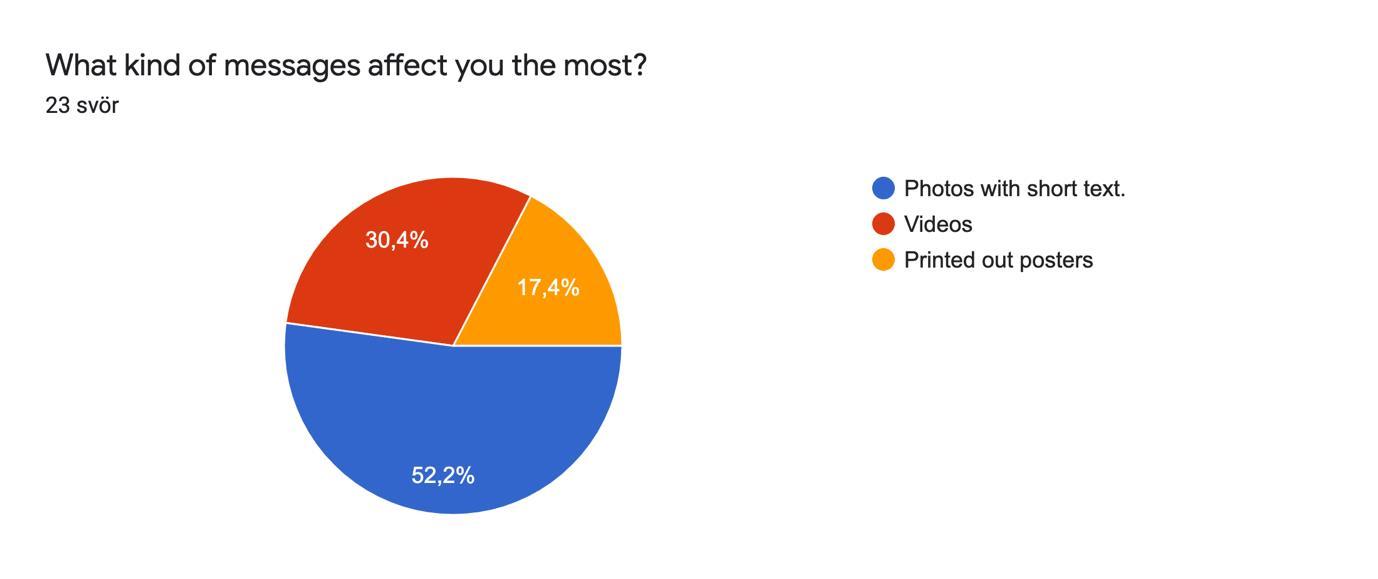
Seeing these answers, what becomes apparent is that the students are most affected by content posted online, as around 80% answered that they wanted to see either a photo with short text or videos. On the other hand, only 17,4% is influenced by printed out posters, which is telling in that people seem to be most affected when perhaps being alone with their phone and seeing the content. These findings are reflected by Nia, who told me that stories affect her the most. Short stories that show what people have been through posted on social media platforms. She thinks that those stories might help others to open up about similar experiences. Henry, an employee at AAK, sha res the same opinion when he says that short and digestible content keeps most audiences in the loop instead of getting lost about what is being mediated. He also adds that what is essential is indicating how the experiences affected the people who have ex perienced GBV, as that factor makes the post more engaging and relatable. Concerning that, he says that the content needs to be entertaining while also being educating. Nadia spoke about her social media platforms and that she has noticed that when she posts videos and pictures of the matter on either Instagram or Twitter, her friends tend to ask her more about her job. That is why she finds the posts being an integral part of the campaign as they are a big part of creating the safe space that is needed: “That’s why I feel like these videos, or like posts with pictures, are very important because they speak the public’s narrative. You know, when I tell you my story, or about something that I have gone through, it speaks to your heart, you know, it’s somethin g that you just take in. So, stories are more powerful because they are making people connect to their emotions.” Nadia continues by saying that this is also why the videos are so instrumental, as they tell stories and show the audience what is happening o ffline. And that is a vital point. When looking through #CampusMeToo and Imara.TV’s social media pages, what becomes apparent, are that the stories being told, either through pictures or videos, seem to show reality. When it comes to the videos, what is shown is both animated and acted stories that can shake people to the core. Mita also tells me that is their goal; they want to show people what is wrong in a society in a raw way. Tacchi (2012) also finds that digital storytelling worked as an interesting way to encourage participation and engage more people's voices. She argues that the three - to five-minute multimedia creations using images made it easier for other people to express themselves. Gray (2009) stresses the same when saying that authentic narr atives found online provided grammar for people to express themselves. When looking through the newly established Instagram page of #CampusMeToo, I can see that this approach has been adopted, which seems to have been done because of popularity, based on t he numbers of likes and comments remarkably higher on posts share real-life stories.
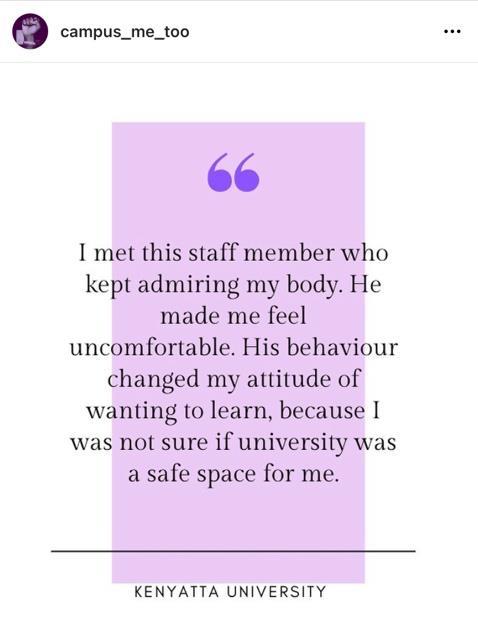


Breaking Taboos
When I have a conversation with John about posting provocative messages as a part of the movement, he tells me that these are sensitive topics in the Kenyan context. By posting them, they are moving towards breaking cultural, political and religious barriers. He adds that it is vital that they do so, bringing out conversations that people usually wouldn’t discuss. Lulu links the silence around these topics to shame. She tells me that there is no other room to talk about them. Lulu uses the topic of GBV as an example by saying that many people blame the women for what has happened by asking them how they were dressed and if they seduced the men with words. She links this to toxic m asculinity and says that women are getting more competent and more independent with more open discussions. What this all goes back to, in her opinion, is power and the people in society who hold it. In that context, she talks about how an intergenerational dialogue should be aimed for, as millennials and Generation Z participate in the campaign. She says that people have to start thinking about getting generation X and boomers on board. Nadia spoke of students who have been suffering in silence, as the topic of GBV is taboo in Kenya. Many young people don’t want to tell their parents about what has happened, which she connects to them never before speaking of matters concerning sex. In other cases, she mentions families coming from the coastal part of Kenya where young people in fragile situations. They can bring about shame on their family if they open up about this concern that is ingrained in the culture and affects different students in different ways. Mita also speaks of the social stigma surrounding GBV and how young people might find it scary to share what they’ve been through: “Because sometimes people just don't know who to talk to. And they only have their phones. Yeah, yeah, like if I tell my mom some of these things, she might not understand. She might judge me and be overly worried, you know, and I would not want to put her through that. But if I can go on my phone, and I find the content from Imara.TV, and maybe I just come across a video or something showing what I have been thro ugh. Because you see the good thing about the videos we have here, they all end with a solution. It's not just the problem; it’s also solving the problem.” All of the student leaders confirmed this by telling me that the reason students step forward is that the conversation is already happening online. What was also expressed is that students now know what to do because of the content. They have started to question if the school has a sexual harassment policy and how they can report a case and essentially find other people they can trust, as this is a platform given to them to heal, talk and relate to each other. They mention noticing positive changes, as people who don’t feel comfortable speaking about the problem use the commenting sections to speak up and share their stories and opinions. Mendes et al. (2018) mirror this from their interlocutors, who explain their emotions following hashtags, mainly received in finding support and feeling like being heard in the form of ‘favourites’, ‘retweets’ or ‘DMs. A significant portion of the participants share the content related to #CampusMeToo on their social media platforms, but what also becomes apparent is that a considerable amount also does not share it. At the same time, only a tiny percentage links that to be afraid of sharing the messages. The fear might stem from shame when not wanting to share their opinion regarding the matter publicly. A relatively significant portion participat es in discussions that happen through WhatsApp groups, which means that even though some individuals won’t share the content, they might read messages sent to them through WhatsApp to participate in the discussions.

When the students were asked if they share #CampusMeToo content on their accounts, 43,5% said they do so, and 17,4% participate in discussions of the matter through WhatsApp. So almost 60% do participate, but 40% say that they don’t share, while the perce ntage of people who don’t since being afraid to do so is relatively small. When it comes to speaking on lived experiences, the content shared online shows how real the problem is and transferring into the student’s well -being in offline spaces. Even though students don’t share the content on their social media pages, they might read the messages and seek someone to hav e a conversation. That development, I argue, is a clear example of how crucial online activism is, as it transfers results onto campus grounds. One informant spoke about the influence the content has on people who want to change their social surroundings and have started campaigning for forums where students can go and meet somebody in person. Some of the Universities have already incorporated counselling offices or guidance centres where students can look for help. Trevor, a student volunteering with #Camp usMeToo, informed me that students also seek to talk to them about their stories. It mainly happens through them sending PM ’s (personal messages) through social media pages, even though some approach them in person on campus. From there, they help to direc t the students in the right direction. Opening further up can be related to trust, which transfers from seeing content online to students wanting to share their stories with #CampusMeToo volunteers by using their social media pages. Thus, online spaces pro vide a “haven” of sorts, where students feel like they can share what is considered sensitive topics with the people who are actively fighting for change in their surroundings by sending them a DM through their Instagram page.
Alone Together
#CampusMeToo has thus far been discussed as a social movement, which I have based on Washko’s (2014) definitions and ideas on collectives addressing cultural issues and working towards change. What is also important is how individuals see themselves as being a part of the movement. What makes the individual so interesting in the case of #CampusMeToo is the element of the devices. Many of those who are participating in the campaign are essentially alone when doing so. Whether it’s the staff members or the students, they either create the content to be shared on their computer or receive it while looking at their phone or a computer screen. But somewhere, somehow, there is a connection. Some kind of contact through the screens. A sort of emotion that makes people feel like they are not alone. They are a part of a group, a movement, a change. Bosch (2017) identified this feeling of belonging as new citizenship formed by individualised activism where people feel like they are a part of a more significant discussion that incorporates them into a shared group identity. A feeling of personal empowerment is created for the individuals participating and can be used to get more people to be involved. The personal empowerment that people tend to experience when seeing themselves as being a part of a movement can be linked to agency and subactivism. What is being done here is focusing on the people behind the screens, which make the campaign a reality. This approach is what Nyabola (2018) describes as starting with the people rather than the structure, which is reflected by Tacchi (2012), who wants to bring focus away from the computer to people’s voices. What is made available by doing so is agency, creativity and negotiations. What Nyabola (2018) says has happened thus far, when agenc y has been neglected in policy work, is that amazing policies and innovations that have nothing to do with the reality of people’s lives have come to the surface. Africans have been portrayed as passive recipients of benign things like technology, as life is just something that has happened to them without them having shaped it themselves in any way, which has led them to be silenced. With the focus on agency, Nyabola shows how people’s narratives are emphasised, allowing for a view of how individuals use n ew spaces to shape their realities. These spaces relate to what was confirmed before through the study, when students occupy the new areas of inclusion created for them through the campaign by sharing content, participating in discussions on WhatsApp and sending DM’s to volunteers. As a result, new realities emerge where the individual can speak on taboo matters, enabled through digital storytelling. The act of giving a “like” on a post or “sharing” it on a Facebook “wall” is based on a choice, based on an individual’s stance on the matter. Their agency comes through this decision making, as they choose to show their personal opinion to their network, whether their friends and family or even other people they want to impress. Trevor, a student leader, brough t about a similar view on social media, saying that it is a choice for people to become involved with the campaign. When posting pictures, texts and videos, it might bring about interest in people and urge them to know more about the topic at hand, which c an be linked to making the activism participatory by creating engaging content. Social media could thus be the initiative brought to people who could then choose themselves what they will do with the information given to them. When audiences are performing the work of listening, which is crucial when it comes to online activism, I argue that they play the role of active listeners when commenting or liking social media posts. Users engage with posts in different ways, but as Dennis (2019), Sharma (2013), and Mendes et al. (2018) manage to show, the work behind acts of liking, sharing, re - tweeting etc., can’t be considered as ‘easy’ or ‘un-real’. When looking at the individual users, their reactions to online content can be categorised as micro -activism, creating the solidarity needed in digital networks, indicating how meaningful each participant is. When looking through the Facebook page of Imara.TV, they frequently post videos that show both acted and animated videos of real-life stories that show viewers what has happened to people who have experienced GBV on campus. Most of the videos have many likes, shares and comments. In the comment sections, people’s reactions are most often positive: These comments on a video posted by Imara.TV, which includes digital storytelling, is how people use to share their stance and support on the matter. Comments like these may be posted by people who can share that they support the campaign and the message. What these comments also provide is a network of people that are fighting towards a shared goal. When people who have been harassed on campus see the video and the positive comments, it might urge them to a mind shift, seeing that they are not the problem, but that this is a structural problem and that they can fight back while receiving support. What the users are indicating is being heard while also showing solidarity and support, and what is more, they are participating in digital activism. The image also shows that Imara.TV reacts to each comment by liking it or even answering most of them. Whether it’s saying “thank you for watching” or engaging in further discussions regarding comments that don’t agree with the video's message. One user comments, „content creative based on realistic things we youths doo“ – directly speaking to the raw and relatable storytelling content, serving as a mirror of society.


As mentioned above, the notion of individualised activism with the feeling of belonging can be used to get more people to be involved with the movement. That feeling was reflected by all of the student leaders I spoke to, which work focuses on raising awareness on the campaign on campus and getting more people on board. To do so, they have come up with creative ways to use online platforms, one of them is to ask other students who have many “followers” on their social media pages to use their platforms for advertising the campaign. These people then get sent content that they post on their Facebook, Instagra m or Twitter pages. Twitter is most often mentioned as the most effective media to gain attention and reach most people in the shortest time. Most of the students appear to be active on Twitter and participate in discussions that happen there and are thus deemed the platform to distribute information to most people. It’s generally required that an “influencer”, or a person that holds a certain status among their social media followers, does something more than post the information. Nia explained this to me: “Yeah, and then when you tell them to do it by themselves, it's another way of creating the awareness because everybody will be interested into, okay, you know, I should do this, I should write this thing about, you know, a friend of mine has gone through this so I should advocate for each, you know, such kind of applies the very good sometimes and get, To be honest, opinion, is passion. Sometimes they say it in a comedic way so that you can attract people. Sometimes they say it in a more advanced way, you know, depending on the group of people that they're conveying the message the information to.” The way of involving students is done so that the person posting is doing so “by themselves”. The student leaders ask that the influencers are true to themselves and post the information in their own way. This independence is reflected in Tacchi’s (2012) s tudy, which found that excluded groups needed to be actively involved in creative ways on their terms, to achieve participation from more people, marginalized or not. What is also tapped into is the receiver’s agency. That is done with personal messages and honest advocating incorporating the needs of different social groups. What is hoped to be sparked on the receiver’s end is that they feel like they belong and relate. Students who a staff member on campus has violated may see the message on the screen and perhaps feel like they are being spoken to personally. Thus, simply receiving this information while looking at a screen may create a sense of agency, of belonging being heard and seen. The content becomes participatory and inviting.
Virtual Familiarity
Ben explains that if the information is posted by either an influencer or friends and family on media platforms, the person seeing the content might feel the urge to comment and, by that, keep the conversation alive while also opening up about their experi ence. Nadia saw this activity as the students taking back power. She went on further by saying that the students are being proactive in participating in the campaign independently from their own space. Going back to Boyd (2014), the Internet and devices provide people with a chance to be a part of the broader public world while being situated in their bedrooms. What is formed is explained by Carminati et al. (2014) as a space of virtuality, which is the combination of familiarity and estrangement, a virtual community rooted in cyberspace with capacities to transform society. Therefore, the forums are making a new space for change to happen, where you see more students and bystanders going from being passive to active allies. Layla spoke of the same matter in a way that signalled the creation of a movement. She underlined the importance of involving students who become passionate activists, taking ownership of the campaign, and even saying, “this is our movement; this is for us and the generations to come”. La yla explained that they want the students to recognize that they are fighting for society but that it will be “their movement so that they know that humans are movements”. This focus is something that most of the students are passionate about, she says. They become very engaged in driving towards change in the learning institutions, which the staff members have created by making these connections between the students, influencers, and individual users. The staff members also spoke of being inter ested in creating connections and making sure that students feel like they are a part of a movement from behind their screens. What also became clear is that the staff members feel a sense of belonging by being employees work concerning the movement. One of them told me that he saw the importance of the movement stemming from them giving students a way to tell their stories. He said that for seven days of the week, there is a need for more engaging and informative voices that are talking about GBV, intending to get the students more involved with empowerment, which he said had become one of the mantras of his life. With his work, he felt like he was doing more for society and learning about the system's issues. Almost all of the staff members repeated this feeling; “We’ve been there, and we’ve seen changes happening, and it’s an honour to be a part of this project. Yeah, I feel like I’m a part of something big that has changed the way lecturers and students interact with each other. Yeah, I feel proud to be a ssociated with the campaign because I was a part of the team that creates the videos. So yeah, I am a part of the campaign.” Another staff member who does not live in Nairobi brought up distance and that even though he’s located thousands of miles away and not in the “front lines”, he is a part of a movement, which he explains as being a part of something important. He explained that when he sees something that triggers him, he feels the need to do something about it and encourage others to do so, making him feel like a part of a movement.
Democratic Involvement
The content creation is based heavily on the audience’s opinions. When they create a short film, John said that they like to share it with people and get feedback. They hope to get constructive feedb ack and even share their content with WhatsApp groups, and that is something that they consider as being essential for the creation of a sense of involving the public in the movement. What I see here is the importance of the content creators at Imara.TV who value voice and listening and are thus enhancing people’s agencies. What is being created is a space of democratic involvement in an important topic, GBV and how it affects people. They want to know first-hand what people want to see and what they don’t want to see. They also deem it essential for Mita to try and answer all the comments they get on their videos and posts, to make people feel like they are engaged in a conversation when they share their opinions. “Because people, people want to feel engaged. And 80% of Imara.TV being an online platform, it has to be an interactive platform. I mean, you want to post questions, you want to feel heard, you want to see who's watching your content, and that’s what we think is interesting.” When finding that they bas e their content so heavily on their audience, I wondered how the comments that speak against the movement affect their work. John told me that they appreciated receiving those comments. “Actually, those are the kinds of comments we love because it means we are sparking conversations that are critical, you know. Yeah. In our culture, such matters are very taboo. Very, very, very conservative and super religious […] And if we can spark those conversations, where people bring out these issues and talk them out , I think we can change attitudes. And that's one of our approaches of impact, changing attitudes around matters of health and around matters of gender. Because now a comment like that, if we have the resources, someone should reply the right way to address such an issue. And with time, we will influence enough people to go out there and influence other people to change the attitudes”. This is grounded in systematic structure and power relations, and as Nyabola (2018) puts it; “The more people move into the se spaces to raise their voices, the more power pushes back. It’s necessary to understand the contours of this pushback too” (p. xviii). What is also apparent is that Imara.TV‘s participatory content creation is sparking creative engagement, which Tacchi (2009) explains as ordinary people being allowed to influence the content in their own mediascape. The creative engagement is welcomed as they view it as a vital part of sparking critical conversations, also with people who are against the campaign, with ho pes to bring positive results. Learning of the campaign’s employees’ approach to these oppositions, as they explain to me that they appreciate the backlash they tackle with the hope of further conversations on the matter with the opposers that might change those attitudes, makes the movement even more substantial. John stresses that these comments stem from ignorance and that he doesn’t blame the individuals; instead, the society has a whole. He underlines that the education system isn’t based on individual decision making but ideology coming from the church. Thus, the comments are topics that are deemed taboo, and that is precisely what Imara.TV and #CampusMeToo work towards using online platforms to open up new spaces where people can have critical conversations based on taboo matters. Gray (2009) explains of how young people tend to be the screens that society projects its fears upon, as parents often see negative aspects of their children’s social media usage. Instead of only focusing on the negative aspe cts, what can be gathered is that young people’s social media usage opens up new spaces for them to share their lived experiences, which is encouraged by participatory content posted online. What is also genuine and stems from John’s answer is that they ar e ready to listen and the people who disagree with the campaign’s messages. Thus, the content is drawing in more than the people who agree, it’s participatory, and the employees are ready to have a conversation through the online platform, be it through comments or DMs. The discussion had will probably affect the person engaging somehow behind the screen, sitting at home on their computer, showing that a comment isn’t just a comment, and a like isn’t just a like.
Discussion & Conclusion Through the ‘in situ’ approach, which was used to introduce the stigma when it comes to being able to speak up on matters of GBV to close relatives, what becomes apparent are two important matters; students turn to online spaces to find a feeling of belonging by bein g seen and heard when it comes to matters of GBV and that within higher learning institutions in Nairobi, ignorance and power structures are limiting students from reporting cases and seeking help. Ginsburg (1991) brings forward other uses of the word media, as defined by the American College Dictionary: „An intervening substance, through which a force acts or an effect is produced, [2] an agency, means or instrument“ related to mediate: „to act between parties to effect an understanding, compromise, reconciliation“ (p. 104). Through usage of films and other content distributed with media, the intention is to mediate something about a culture between groups separated by space, time, knowledge and prejudice with the aim of creating an understanding (ibid.). What I argue is that the short films and the content posted through AAK’s and Imara.TV’s online platforms serve to mediate a message, with hope to close the gap of space, time, knowledge and prejudice, between generations and students and staff, that might watch and learn something new and create empathy and understanding. What this thesis aimed to answer is how and if digital activism helps development organisations reach their goals. As presented, the interlocutors expressed that their work would not be possible without social media, as it gives them advances overlaying time and space. I argued that by placing a campaign online, people are provided spaces to participate, share their stories and grab fundamental tools while being a part of social networks. I used Bolin’s (2007) three areas of media consumption; production practices, distribution technologies and audience reception to answer the research question and will thus represent the findings through each pillar.
Production Practices
When it comes to production, I aimed to find out how employees at AAK and Imara.TV as well as student activists view the campaign’s online presence and content creation. Apart from seeing online activism as vital for the campaign, themes of listening and voice arose alongside topics of participatory content creation. As Tacchi (2012) argues, emphasis for a rights -based approach to international development has often been set on creating platforms making sure that people’s voices are hea rd, with less attention given to listening. The process of listening means giving attention to different actors and make it available for everybody to be heard (ibid.). Juris (2005) explains that as digital technologies are inscribed into organisations, a conversation is created between technology and norms which open s a space for activists to participate in networks of horizontal collaboration. The space which is created online was mentioned by almost all the interlocutors, when they described that people had started to send DMs to them personally through Instagram. The messages being sent to them came from people that either wanted to tell them about their stories by writing through the app or asking if they could meet sometime on campus. The interlocutors expressed that they want to listen and make space for people to speak their truth. When speaking of how this is made possible, critical content creation became a fundamental topic. As Tacchi et al. (2009) argue, development organisations must deliver meaningful ways of incorporating participation, beyond looking good on paper. This entails a focus on the local context and content -creation that fits into already existing communication networks or by creating new ones which allow for ordinary people in co-creation of knowledge (ibid.). This is presented when Imara.TV speaks of the value found in allowing the audience to influence their work, both when they share content for feedback and when having conversations with those who oppose the messages of the campaign. This is what the staff members of Imara.TV clearly aim to create, a platform for students to tell their stories while also feeling like being a part of something bigger, which has influence to change important social matters. This links back to subactivism, which sheds light on people who are participating in political discussions, through social media platforms embedded in their everyday lives. Their individual agency is realised at the same time, as they are taking sides regarding actions and debates that are connected to the larger social world. The Internet is thus helping with the leap between close personal relationships, where private concerns are shared, into the public state, which is necessary to affect changes. The personal is transformed in to political (ibid.; Hanisch, 2006). As Tufekci (2014) argued, the symbolic act of clicking, liking and sharing might well be one of the most important things that the internet allows for. Vink (2018) argues that online activism can have the power to make big impact and cites Joel Penney who states that: „Although each individual act of posting, linking, commenting and liking may look insignificant up close, at a macro level [all together] they add up to nothing less than the networked spread of ideas“ (Vink, ibid; 76).
Distribution Technologies
The focus regarding distribution technologies was set on finding out how interlocutors seek to make sure that what is being done online has effects offline. What I also wanted to reject is that participating online is easy or unreal. To do so, I spoke of changes that have started to happen in the offline spheres due to online activism, which were presented to me through stories. One was about a professor who had been recorded, which was shared on Twitter r esulting in him facing consequences, another of students pushing for sexual harassment policies in their universities and stories of individuals deciding to participate in discussions on GBV because of the conversation already happening online. Those discussions are made available in offline spaces, when employees offer to meet and with more consultants being hired into universities, where students can feel like they can speak up, report cases and receive support having their experiences recognized. In a do cument made available to employees at AAK about #CampusMeToo (ActionAid, n.d.), the success of the campaign is based on the assumption that universities will implement an anti -sexual harassment policy in collaboration with the students. What is also mentioned, is that this might be difficult to achieve, as staff with a negative record will likely try to block the students from filing complaints (ibid.). As online spaces affect offline spaces , as has been mentioned before, to measure if a campaign is successful or not, it must go beyond the digital sphere and make a difference on the ground. But what has happened since the beginning of the campaign in 2019, is that committees have been formed by university staff which are currently working on po licy briefs on collaboration with the ministry of gender. Different universities have started to work more together and education programmes on GBV, for both students and staff, is being created and implemented for all higher learning institutions. Students have started to speak up, saying that they want to be listened to and what they want to be heard is that professors should be made accountable for cases of sexual harassment.
Audience Reception
The audiences in this thesis are the students and I wanted to grasp how they perceive the content and the presence of the campaign. The results from the questionnaire suggest that students both want to see more of online and offline materials coming from the campaign, and I thus argue for both furthering of online content and face-to-face initiatives among students. What I further suggest for both organisations, is to gather more stories and continue to share short films on social media, which are providing platforms for voices that have continually been left out . Hiring local organisations, such as Imara.TV, d one by AAK, enables the voices of the local people to be heard and for attention to be given to debates from the local context. Rethinking the Smartphone I have been concerned to articulate how the smartphone in particular has started to play such a vital role in the lives of youth in Nairobi. The smartphone is popular because it provides people the affordance of disappearing into their other ‘home’, where no subjects are deemed taboo and shared lived experiences are there to read. Real life stores, shared through short films and social media posts, offer arenas for individual realisations of not feeling alone when struggling after being harassed but feeling seen and heard, perhaps for the first time. For students in Nairobi, looking through social media on their smartphones, is only one part of everyday life but getting a sense of support while doing so, is something that makes the meaning of the device change to a vital necessity. The same is underlined by Goggin and Clark (2009) who show how the mobile pho ne facilitates initiations made by innovative development strategies and enables them to access global networks, which help to break down traditional structures of power. This becomes apparent not only in the everyday life but also in activating a dimension of human rights „If we take seriously the proposition that society is made anew alongside new technology, rather than simply one determining or influencing the other, then the mobile phone is an occasion for experimentation and opening up and rethinking community-development practice (Goggin and Clark, 2009, p. 595).
Media Contributions to Development
Lastly, I want to suggest further research on the matter to be done in Nairobi, with focus on students that have experienced GBV on campus and the effects of online content creation has had on them. A participatory approach in such research could according to Noske -Turner (2017) entail incorporation of local perspectives when it comes to vision, design, goals and values of the media practices, which would then help to move away from international generic definitions and bring forward a reasonable understand ing for success. What Noske -Turner (ibid.) also brings forward is that media’s contribution to development as gone under - recognized and that further media development analysis would showcase such projects worth and offer benefits for media assistance . During the previously mentioned conference held by UN Women, the theme of societal gendered norms emerged from a range of the speakers. They emphasized that girls need to be included in content creation, which could be done through the usage of increased emplo yment opportunities made available in technical spheres. Online spaces could thus create spaces for women to be employed and play a vital role in removing cultural taboos regarding gendered roles ( UN Women Africa, March 30 th, 2021). The importance of online activism would then become even more valuable for development by providing new spaces, both offline and online.
Bibliography
Abuya, B.A., Ngware, W.M., Mutisya, M. & Nyariro, M. (2016). Girls’ Primary
Education and Transition to Secondary School in Nairobi: Perceptions of Community Members at the Onset of an Education Intervention. International Journal of Adolescence and Youth, 22(3); 349-363.
ActionAid. (n.d.). The #CampusMeToo Campaign [Unpublished Manuscript]. Action Aid Kenya.
Ahearn, L.M. (2000). Agency. Journal of Linguistic Anthropology, 9(1-2); 12-15.
Ahmed, S. (2019). A Complaint Biography. Biography, 42(3); 514-523. Doi:
https://doi.org/10.1353/bio.2019.0057
Arreola, V. (2013). Back to the #FemFuture. Viva La Feminista. Retrieved from: http://www.vivalafeminista.com/2013/04/back-to-femfuture.html
Austrian, K., Bruce, J. & Maternowska, M.C. (2017). Early Empowerment: The Evolution and Practice of Girls’ “Boot Camps” in Kenya and Haiti. In S.L. Dworkin,
Gandhi, M. & Passano (eds.), Women’s Empowerment and Global Health: A
Twenty-First Century Agenda (93-116). University of California Press.
Baer, H. (2016). Redoing Feminism: Digital Activism, Body Politics and Neoliberalism. Feminist Media Studies, 16(1); 17-34.
Bakardjieva, M. & Gaden, G. (2012). Web 2.0 Technologies of the Self. Philosophy & Technology, (25); 399-413.
Bakardjieva, M. (2012). Subactivism: Lifeworld and Politics in the Age of the Internet. In A. Feenberg and N. Friesen (eds.). (Re)Inventing the Internet: Critical Case Studies (85-108). Sense Publishers.
Berns, N. (2001). Degendering the Problem and Gendering the Blame: Political Discourse on Women and Violence. Gender and Society, 15(2); 262-281.
Bolin, G. (2007). Media Technologies, Transmedia Storytelling, and Commodification. In Storsul, T. & Stuedahl, D. (eds.), Ambivalence towards Covergence: Digitalization and Media. Göteborg: Nordicom.
Bonilla, Y. & Rosa, J. #Ferguson: Digital Protests, Hashtag Ethnography, and the Racial Politics of Social Media in the United States. Journal of the American Ethnological Society (42); 4-17.
Bosch, T. (2017). Twitter Activism and Youth in South Africa: The Case of #RhodesMustFall. Information, Communication and Society, 20(2); 221-232.
Bourque, S.C. & Warren, K.B. (1990). Access is not Enough: Gender Perspectives on
Technology and Education. In Irene, T. (ed.), Persistent Inequalities. New
York: Oxford Univesity Press.
Boyd, D. (2010). Social Network Sites as Networked Publics: Affordances, Dynamics,
and Implications. In Z. Papacharissi (ed.), Networked Self: Identity,
Community, and Culture on Social Network Sites (39-58). Taylor & Francis Group.
Boyd, D. (2014). It’s Complicated: The Social Lives of Networked Teens. United
Kingdom: Yale University Press
Bunch, C. & Carillo, R. (1990). Feminist Perspectives on Women in Development. In Irene, T. (ed.), Persistent Inequalities. New York: Oxford University Press.
Carminati, B., Ferrari, E. & Viviani, M. (2014). Security and Trust in Online Social Networks. Morgan & Claypool Publishers.
Castells, M. (1996). The Rise of the Network Society. Oxford: Blackwell.
Chambers, R. (1994). Paradigm Shifts and the Practice of Participatory Research and
Development. IDS Working Paper no. 2. Brighton: Institute of Development
Studies.
Chen, G.M., Pain, P. & Barner, B. (2018). “Hashtag Feminism”: Activism or Slacktivism?
In D. Harp, J. Loke & I. Bachmann (eds.), Feminist Approaches to Media
Theory and Research, Comparative Feminist Studies, (197-219). Palgrave
Macmillan.
Coleman, E.G. (2010). Ethnographic Approaches to Digital Media. Annual Review of Anthropology, (39); 487-505.
Cornwall, A. & Brock, K. (2005). What do Buzzwords do for Development Policy? A Critical Look at “Participation,” “Empowerment,” and “Poverty Reduction”. Third World Quarterly, 26(7); 1043-1060.
Daniels, J. (2016). The Trouble with White Feminism: Whiteness, Digital Feminism and
the Intersectional Internet. In B. Andre, N, Safiya & T. Brendesha (eds.), The
Intersectional Internet, Section Two: Cultural Values in the Machine. New
York: Peter Lang Publishing
Dennis, J. (2019). Beyond Slacktivism: Political Participation on Social Media. UK: Palgrave Macmillan.
Dixon, K. (2014). Feminist Online Identity: Analyzing the Presence of Hashtag Feminism. Journal of Arts and Humanities, 3; 34-40.
Douglas, S. J. (2019). Media, Gender and Feminism. In J. Curran & D. Hesmondhalgh (eds.), Media and Society. London: Bloomsbury Academic.
Durkheim, E. (1951[1897]]. Suicide: A Study in Sociology (Le suicide. Étude de sociologie). New York: The Free Press.
Feenberg, A. (1999). Questioning Technology. London: Routledge.
Feenberg, A. (2009). Critical Theory of Communication Technology: Introduction to the Special Section. The Information Society, 25; 77-83.
Feenberg, A. (2017). Agency and Citizenship in a Technological Society. In A. Shew & J.C. Pitt (eds.). Spaces for the Future: A Companion to Philosophy of Technology. New York: Routledge.
Fotopoulou, A. (2016). Feminist Activism and Digital Networks: Between Empowerment and Vulnerability. UK: University of Brighton.
Giddens, A. (1990). The Consequence of Modernity. Cambridge: Polity.
Ginsburg, F. (1991). Indigenous Media: Faustian Contract or Global Village? Cultural Anthropology, 6(1); 92-112.
Ginsburg, F. (1994). Some Thoughts on Culture/Media. Visual Anthropology Review, 10(1); 136-141.
Ginsburg, F. (2008). Rethinking the Digital Age. Global Indigenous Media: Cultures,
Poetics, and Politics. In Pamela Wilson & Michelle Stewart (eds.). Durham:
Duke University Press.
Goggin, G. & Clark, J. (2009). Mobile Phones and Community Development: A Contact Zone Between Media and Citizenship. Development in Practice, 19(4/5); 585-597.
Gray, M.L. (2009). Negotiating Identities/Queering Desires: Coming Out Online and the Remediation of the Coming-Out Story. Journal of Computer-Mediated Communication (14); 1162-1189.
Gross, L.P. (2007). Forward. In K. O’Riordan & D.J. Philips (eds.), Queer Online: Media, Technology, and Sexuality (vii-x). New York: Peter Lang.
Hanisch, C. (2006). The Personal is Political. Available online: https://webhome.cs.uvic.ca/~mserra/AttachedFiles/PersonalPolitical.pdf (accessed on 17 June 2021)
Haraway, D. (1988). Situated Knowledges: The Science Question in Feminism and the Privilege of Partial Perspective. Feminist Studies, 14(3); 575-599.
Hermanns, H. (2008). Mobile Democracy: Mobile Phones as Democratic Tools. Politics, 28(2); 74-82.
Horst, H. (2012). New Media Technologies in Everyday Life. In H. A. Horst & D. Miller (eds.), Digital Anthropology (61-79). Taylor & Francis Group.
Imara.TV. (2019, 29th of November). #CampusMeToo [video]. Youtube. https://www.youtube.com/watch?v=EvTECBdo1eY&t=61s
Juris, J. S. (2005). The New Digital Media and Activist Networking within Anti-Corporate
Globalization Movements. The Annals of the American Academy of Political
and Social Science, (597); 189-208.
Kaplan, A. M. And Haenlein, M. (2010). Users of the World, Unite! The Challenges and Opportunities of Social Media. Business Horizons, 53(1); 59-68
Kapoor, I. (2005). Participatory Development, Complicity and Desire. Third World Quarterly, 26(8); 1203-1220.
Kapoor, I. (2013). Celebrity Humanitarianism: The Ideology of Global Charity. London: Routledge.
Karusala, N., Perrier, T. & Kumar, N. (2019). #IfAfricaWasABar: Participation on Twitter across African Borders. In A. Kosnik & K. P. Feldman (eds.), #Identity:
Hashtagging Race, Gender, Sexuality and Nation. University of Michigan
Press.
Knibbs, K. (2013). Slacktivist, Unite! Social Media Campaigns Aren’t Just Feel Good
Back Patting, Digital Trends. Available on:
www.digitaltrends.com/opinion/slacktivists-unite-social-media-campaigns
- arent just-feel-good-patting/.
Loftsdottir, K. (2015). International Development and the Globally Concerned European Subject. Interventions, 18(2), 234-250.
Mackay, F. (2015). Radical Feminism: Feminist Activism in Movement. London: Palgrave Macmillan.
Macnamara, J. (2013). Beyond Voice: Audience-Making and the Work and Architecture of Listening as New Media Literacies. Continuum: Journal of Media & Cultural Studies, 27(1); 160-175.
Martin, C. & Valenti, V. (2013). The Future of Online Feminism. Barnard Center for Research on Women.
Mbarika, V.W., Payton, F.C., Kvasny, L. & Amadi, A. IT Education and Workforce
Participation: A New Era for Women in Kenya? Information &
Communication Technology – Africa, 12.
Melluci, A. (1996). Challenging Codes. Cambridge: Press Syndicate of the University of Cambridge.
Mendes, K., Ringrose, J. and Keller, J. (2018). #MeToo and the Promise and Pitfalls of
Challenging Rape Culture through Digital Feminist Activism. European
Journal of Women’s studies, 25(2); 236-246.
Miller, D. & Horst, H. (2013). The Digital and the Human: A Prospectus for Digital Anthropology. In Horst, H. & Miller, D. (eds.), Digital Anthropology, (p. 3 36). Taylor & Francis Group.
Miller, D. & Slater, D. (2002). Relationships. The Anthropology of Media: A Reader. In K. Askew & R.R, Wilk (eds.). Oxford: Blackwell Publishers Ltd.
Miller et al. (2021). The Global Smartphone: Beyond a Youth Technology. London: UCL Press.
Morgan, N., Jones,G. And Hodges, A. (2011). Social Media. The Complete Guide to
Social Media from the Social Media Guys. Retrieved from: https://rucreativebloggingfa13.files.wordpress.com/2013/09/completeguidetosocialmedia. pdf
Noske-Turner, J. (2017). Rethinking Media Development through Evaluation. UK:
Palgrave Macmillan.
Nyabola, N. (2018). Digital Democracy, Analogue Politics: How the Internet Era is
Transforming Politics in Kenya. London: Zed Books
Omale, J. (2000). Tested to their limit: Sexual Harassment in Schools and Educational
Institutions in Kenya. In J. Mirsky & M. Radlett, (eds.), No Paradise Yet:
The World’s Women Face the New Century. London: Panos Institute and
Zed Books.
Onyejekwe, C. (2011). The Internet: Empowering Women? Pakistan Journal of Women’s Studies, 18(2); 53-63.
O’Reilly, K. (2012). Ethnographic Methods. USA: Routlegde.
Peacock, J. (1986). The Anthropological Lens: Harsh Light, Soft Focus. Cambridge: Cambridge University Press.
Reeves, H. & Baden, S. (2000). Gender and Development: Concepts and Definitions. Institute of Development Studies (55), Brighton: BRIDGE.
Rose, G. (1997). Situating Knowledges: Positionality, Reflexivities and Other Tactics. Progress in Human Geography, 21(3); 305-320.
Sharma, S. (2013). Black Twitter? Racial Hashtags, Networks and Contagion. New
Formations, 78; 46-64.
Smaradottir, K. (2021). Academic Internship Report [Unpublished Manuscript]. University of Copenhagen.
Tacchi, J. (2002). Radio Texture: Between Self and Others. In Askew, K. & Wilk, R. R.
(eds.), The Anthropology of Media: A Reader. Oxford: Blackwell Publishers
Ltd.
Tacchi, J. Watkins, J. & Keerthirathne, K. (2009). Participatory Content Creation: Voice, Communication, and Development. Development in Practice, 19(4/5); 573 584.
Tacchi, J. (2012). Digital Engagement: Voice and Participation in Development. In Horst, H. & Miller, D. (eds.), Digital Anthropology, (225-241). Taylor & Francis Group.
Tufekci, Z. [Zeynep]. (2014). These Symbolic, Epistemic Acts Online – Derided as “Slacktivism” – May Well Be Among the Most Important Effects of the Internet. Tweet. Retrieved February 3, 2013.
UNICEF. (2021). Kenya Country Kit 2020-22: A look at progress on Children’s Rights in Kenya and UNICEF’s Response.
UN Women Africa. (March 30th 2021). Harnessing Technology/Innovation and Youth Activism to Effectively Respond and Prevent Violence against Women and Girls in Kenya [Online Conference]. Available on: https://www.facebook.com/watch/live/?v=274457490818286&ref=watch_permalink
Vasiliauskaite, V. & Rosas, F.E. (2020). Understanding Complexity via Network Theory: A Gentle Introduction. Data Science Institute: Imperial College London.
Vink, A. (2018). Hacktivism and Slacktivism. In A. Vink (ed.), Online Activism: Social Change Through Social Media, (56-76). Greenhaven Publishing LLC.
Waltorp, K. (2020). Why Muslim Women and Smartphones. London: Bloomsbury
Publishing
Washko, A. (2014). Out of the Kitchen, Onto Your Screen, Into the Ether: A Case for an
Online Art and Feminism Social Movement. A Feminist Art Movement
Online. Retrieved from: http://netartnet.net/news/texts/item/830-a-feminist art movement-online
Watkins, J. & Nair, S.B. (2008). Optimising ICT Initiatives through Content Creation. In J.Watkins and J. Tacchi (eds.), Participatory Content Creation for Development: Principles and Practices. New Delhi: UNESCO.
Wasserman, S. & Faust, K. (1994). Social Network Analysis. Cambridge University Press.
Appendix
Interviewees
A list of interviewee’s synonyms:
Adan AAK Employee
Nadia AAK Employee
Layla AAK Employee
John Imara.TV Manager
Calvin Imara.TV Manager
Joseph Imara.TV Content Creator
Reagan Imara.TV Software Developer
Peter Imara.TV Software Developer
Mita Social Media Manager
Ben Student/Volunteer
Trevor Student/Volunteer
Nia Student/Volunteer
Lulu Counsellor
Interview Guide
This interview guide was used when speaking with staff of Imara.TV and AAK.
- Introduction a. Could you tell me about your work for Imara.TV/AAK? i. When did you start working for Imara.TV/AAK? ii. Which projects do you mainly focus on? iii. Who do you mainly work with? b. How is a normal workday for you? c. Why did you decide to apply for a job at Imara.TV/AAK?
- Content Creation a. How do you get an idea for creating content? i. What do you base that idea on? ii. Where do you get inspiration? b. What makes some content perform better than other? i. How important is the content itself? ii. What role does the message of it or the way it’s done play? iii. Does it need to be fun? (have colours, good voice, technical skills, something else?)
- The Audience a. From your perspective, how important is it to communicate with the audience?
Why?
b. Who do you see as the ideal audience for the content? i. Do you think that the people who should/need to see the content are the ones seeing it? c. What do you know about the people engaging with the content online? i. Do you know who they are? d. What, if anything, do you wish could be changed or improved in terms of who sees and engages with the content?
- The Campaign a. Do you feel like you’re a part of a movement through Imara.TV/AAK? i. Do you feel like you’re working towards common goals? ii. Do you feel more involved in social issues? iii. Has it affected you personally to work there? b. Have you seen changes being made as a result of the social media campaigns for #CampusMeToo? i. If so, what are the effects? c. What challenges to you see to making change in society via computers and social media? d. How important is it for a company like Imara.TV/AAK to get to flourish in
Nairobi?
i. Why?